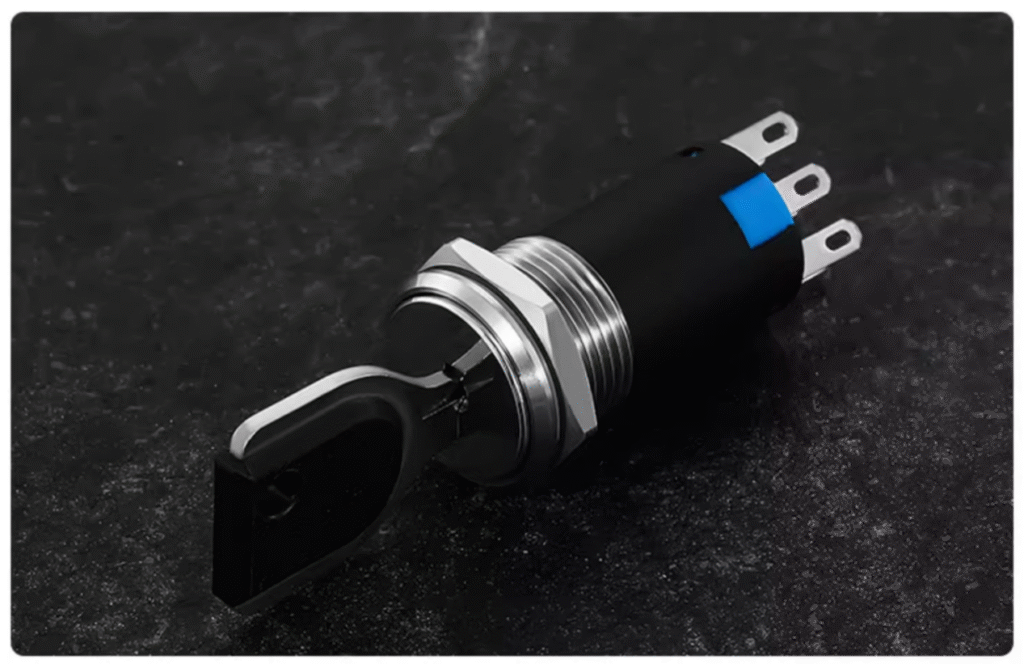
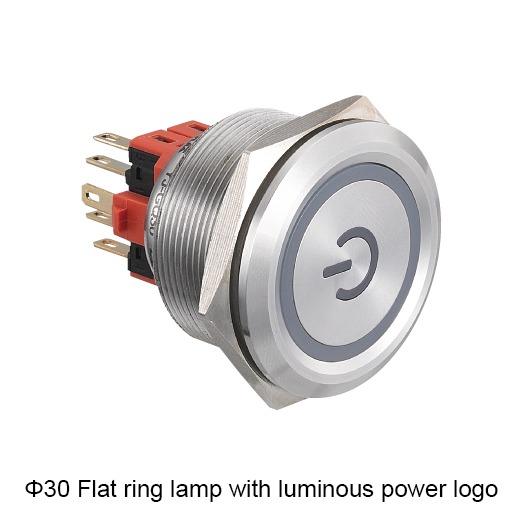
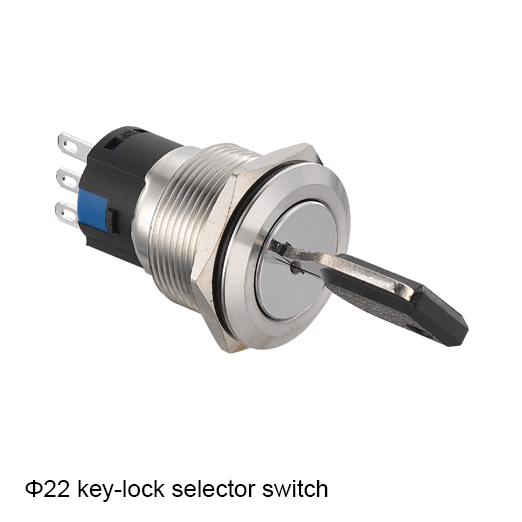
A push button can fit a panel perfectly and still be wrong for its circuit. The contacts may operate differently, the LED may require another supply, or the rear terminals may leave too little room for a secure connection. These details matter more than the number of wires visible in a product photograph.
If you are sourcing a push button with wiring, first establish whether you need a terminal equipped switch or an assembly supplied with attached leads. Then check how its contacts and illumination will connect to the equipment. This guide explains those decisions using YIJIA metal push buttons as a product reference.
What changes when a push button is pressed
Inside a mechanical push button, actuator movement changes the state of one or more contacts. A normally open contact is open at rest and closes when operated. A normally closed contact does the opposite. The circuit determines what that change accomplishes: requesting a cycle, acknowledging an alarm or interrupting a control signal.
A momentary switch returns when released. A maintained switch remains in its operated state until its specified release action occurs. These actions are separate from contact arrangement. Do not assume that momentary means normally open, or that every maintained switch releases with a second press.
For example, a momentary start command can initiate a machine cycle that continues after release. The controller or control circuit retains that request. The button itself does not need to latch mechanically. Conversely, holding a button does not necessarily keep equipment running if other conditions prevent operation.
Identifying contacts before connecting wires
Start with the exact ordering code and the manufacturer’s connection drawing. Find the switch contact terminals and, where present, the lamp terminals. Some switches provide a common terminal with normally open and normally closed connections; others use separate contact pairs. Terminal layouts are not interchangeable across products.
Wire count is an unreliable shortcut. Two conductors might serve a single contact pair, while additional conductors could belong to an LED or another contact. Colours help only when their functions are documented for that assembly. Never transfer a colour convention from an unrelated button to a new model.
With equipment isolated and the device disconnected as appropriate, a qualified technician can check contact continuity against the drawing. Record the state at rest and during operation. Do not apply voltage simply to discover which terminals belong to the lamp. If markings are unclear, request documentation before connecting the device.
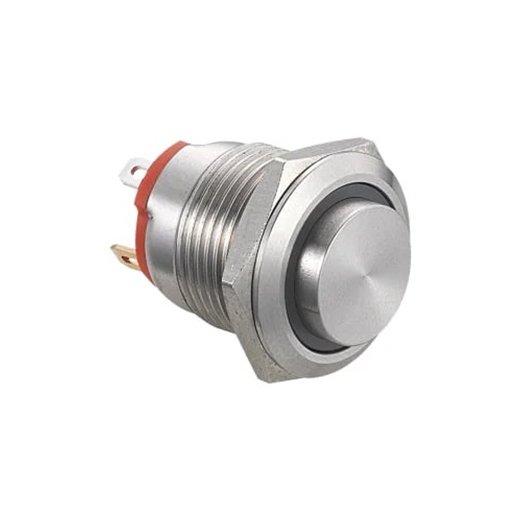
YIJIA YJ-GQ16 short type metal push button • Official product photograph
Selecting a YIJIA metal push button
YIJIA’s YJ-GQ16 short type page lists a nominal 16 mm installation size, momentary operation and a 1NO contact arrangement. It also identifies screw and pin terminal wiring options. These details provide a starting point for a compact metal control, but the final ordering code must match the intended assembly.
The listed actuator material is stainless steel. Shell options include stainless steel, plated brass and plated aluminium alloy, while the base is an insulating material. Specifying a metal button therefore requires more detail than simply writing stainless in a purchase order. Identify the component and finish you need.
Check the mechanical drawing for panel thickness, mounting clearance and rear access. A short switch body may help in a shallow enclosure, but terminals, a connector and cable bends still need space. Confirm the actual configuration with YIJIA; the product page notes that not every theoretical model combination is available.
Choosing terminals or an attached lead assembly
Screw terminals can support serviceable connections when the conductor preparation and tightening method match the manufacturer’s instructions. Confirm the accepted conductor size and specified torque. Excessive tightening can damage a connection, while insufficient tightening can leave it unreliable. Do not use a general torque value from another switch series.
A pin terminal version needs the connection method specified for that model. Where soldering is permitted, follow the stated temperature and contact time limits. Where a connector is used, identify the correct mating part, orientation and retention method. A connector that appears to fit is not proof of compatibility.
Attached leads can simplify repetitive assembly, but their specification must be explicit. Agree wire length, conductor size, insulation, end preparation and identification. Confirm whether the order includes the switch alone, a connector, or a completed assembly. A catalogue listing of wiring options does not establish that a harness is supplied.
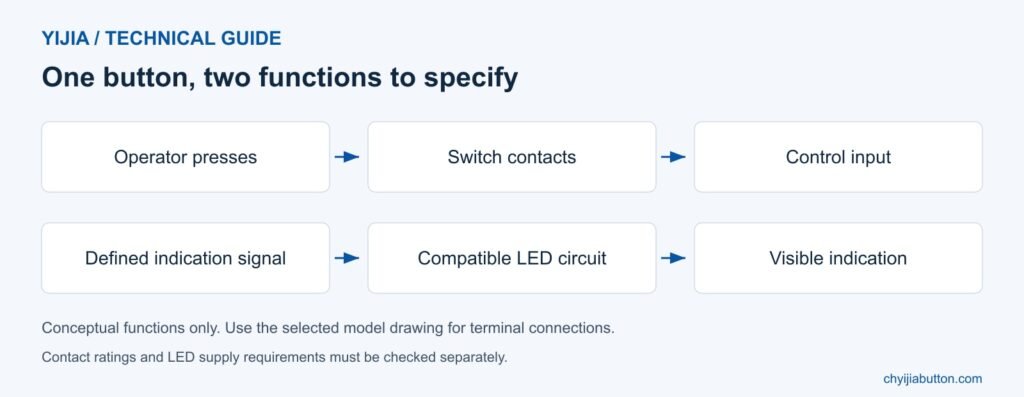
YIJIA contact and lamp functions • Conceptual diagram, not a model pinout
Keeping the LED circuit separate in the specification
An illuminated push button combines a switching function with a light source. Treat them as two electrical checks. The contact rating describes the switching duty; the lamp specification describes its supply requirements. A 24 V LED label does not establish the contact current rating or suitability for a particular load.
Define what the light should indicate. A lamp connected to a supply may show that power is available. A lamp driven by controller feedback may indicate a confirmed machine condition. Neither meaning follows automatically from the button being pressed. Choose the indication logic before deciding how the lamp is connected.
Check AC or DC compatibility, polarity where applicable, and whether any additional components are required. Do not assume every illuminated model uses the same internal circuit. Keep contact and lamp functions clearly identified on the assembly drawing so installation staff do not have to interpret them from appearance.
Matching the circuit and installation environment
Record the operating voltage, current and load type. A controller input, relay coil and resistive load present different switching conditions. Use the applicable AC or DC rating for the selected model. A high headline current rating does not automatically establish reliable switching at very low signal levels.
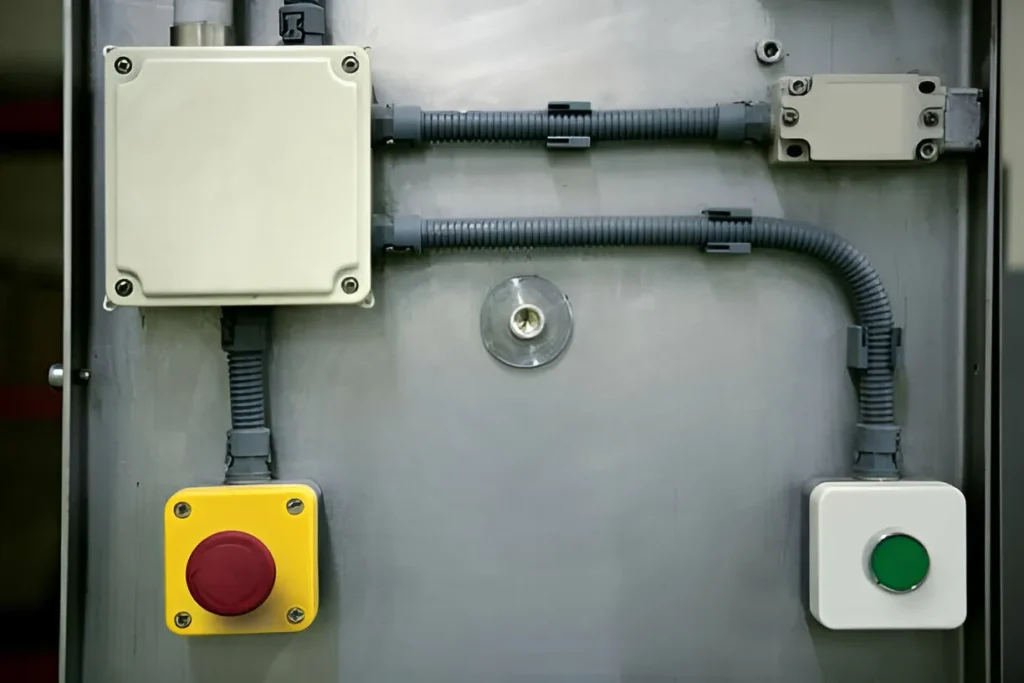
A push button used for a start command will often operate a control input rather than carry motor current directly. Keep the control device and power switching equipment distinct in the design. Likewise, an ordinary red button is not automatically an emergency stop device; safety functions require suitable components and system design.
Environmental protection applies under defined conditions. A metal housing does not make every terminal waterproof, and protection at the panel face does not necessarily extend to rear connections. Consider moisture, cleaning agents, temperature and vibration across the complete installation. Verify the declared protection and sealing requirements for the ordered configuration.
Routing and checking the completed wiring
Support cables so movement or servicing does not pull on the terminals. Protect conductors from sharp panel edges and moving parts. Leave enough allowance to open a door or disconnect a component, while keeping loose wiring clear of neighbouring equipment. Check that the finished connection remains accessible for maintenance.
Before commissioning, compare the installed assembly with the approved drawing. Confirm terminal identification, contact action, lamp supply and connector retention. Investigate an unexpected response rather than swapping wires experimentally. Testing should follow the equipment’s isolation and commissioning procedures, with the responsible technician verifying operation before the machine returns to service.
For repeat production, retain the switch ordering code alongside the wire assembly drawing. Changes to connector orientation, lead length or termination can affect fit and servicing even when the front appearance stays identical. Review those changes before approving another batch, and keep purchasing and assembly records consistent.
If the lamp works but the command does not, the light alone cannot identify the fault. The contact wiring, selected contact state, controller input and control logic each need checking. If the command works but the lamp remains dark, investigate the indication circuit against its specification. These symptoms help organise checks; they do not justify bypassing protective devices. Record the observed behaviour and any recent wiring or component changes before troubleshooting, so the technician can compare the actual response with the intended sequence and identify where the two diverge.
Requesting the right configuration from YIJIA
Send YIJIA the mounting requirement, operating action, contact arrangement and electrical duty. Add the desired actuator finish, illumination details and installation environment. For an attached lead request, include a connection drawing and the required wire specification. Ask which components and assembly operations are included in the proposed supply.
For replacements, provide the existing part number and photographs of both the front and rear connections. Request a sample when panel fit or connection access needs verification. Approve the complete configuration before ordering quantities, including any accessories, so the delivered assembly matches the equipment rather than only its visible actuator.
FAQ
Does every push button come with wires
No. Many switches are supplied with terminals for the installer to connect. Leads, connectors and completed harnesses must be identified in the confirmed order. Ask what is included rather than relying on the product photograph.
Can I connect a button using only wire colours
Only when an approved drawing defines those colours for that exact assembly. Colours alone do not establish contact or LED functions. Use terminal markings and documentation, especially when changing suppliers or replacing a discontinued part.
Is a momentary button suitable for a start command
It can be, when the control circuit accepts a temporary input and manages the subsequent operation. Check the required contact arrangement and electrical duty. The machine’s response depends on its control design, not simply on the actuator mechanism.
Can the lamp and contacts use different voltages
They may serve different circuits when the selected device and equipment design permit it. Confirm lamp requirements, contact ratings and the necessary insulation and separation. Never assume independent terminals alone make every voltage combination acceptable.
What information helps identify a replacement
Provide the ordering code, contact diagram, panel dimensions, operating action and lamp specification, plus clear photographs of the rear connections. Include any connector or lead drawing. Matching head diameter and wire count is not enough to confirm compatibility.
Title: Push Button Wiring Guide for Control Panels | YIJIA
Description: Understand push button wiring, NO and NC contacts, LED circuits and terminal options. Check your control panel requirements with YIJIA before ordering.
Keywords: push button wiring, push button with wiring, metal push button switch, NO NC contacts, illuminated push button wiring, YIJIA
What is a plastic button box The plastic button box is a protective device that is mainly used to install and fix various buttons and switches to facilitate operation and protect the components from the external environment. This kind of button box is mostly made of plastic material and is widely used in industrial and […]
What is a relay switch circuit? Relay switching circuit is an electrical control system mainly composed of relays. A relay is an electromagnetic switch capable of controlling one or more high-current or high-voltage circuits in an electrical circuit, operating with a lower voltage or current control signal. This kind of circuit is widely used in […]
Installation dimensions: φ16MMCurrent: 5A/10A/15A/18AOperation: momentary / latching-cabinet latchIP degree: lP40 (waterproof industrial push button switch)The shell material: brass clad Chromium/stainless steel Want to know more about the product: Metal Push Button Switch Yijia YJ-GQ16 Metal lP40 Selector Switch is a high-quality product specially designed for industrial control. It combines the convenient operation of traditional push […]
We use cookies to enhance your browsing experience, serve personalised ads or content, and analyse our traffic. By clicking "Accept All", you consent to our use of cookies.