An LA36 push button should not be specified by its front appearance alone. The operator may look like one simple button, but the switching work takes place behind the panel. A single machine command may require one normally open contact, one normally closed contact, or several independent contacts connected to different parts of the control circuit.
The correct number of contact blocks therefore comes from the circuit logic, not from the button color or head shape.
YIJIA’s LA36A product page describes the series as a 22 mm modular push button system. It lists contact arrangements such as 1NO1NC, 2NO, 2NC, 1NO and 1NC, and explains that the switch base can be assembled with multiple switching elements. The same page also warns buyers that a model-code table is explanatory and that not every possible code combination represents an actual available product.
That limitation matters. Buyers should define the required control functions first, then ask the supplier to confirm the complete available configuration.
Start with the Control Functions, Not the Contact Count
Before choosing contact blocks, write down every electrical action that must occur when the operator presses, releases or resets the control.
For a basic start command, the control circuit may need one normally open contact. The contact closes only when the operator performs the required action. A stop command may use a normally closed contact so that the circuit is closed in its normal state and opens when the operator presses the button.
More complex controls may need two electrically separate actions from the same operator. One contact may send a command to a controller, while another contact operates an indication, interlock or auxiliary circuit. These functions should not be combined casually. Each circuit must be identified on the electrical drawing, including its normal state and what must happen during operation.
A useful specification starts with statements such as:
Circuit 1 requires one normally open contact for a start input.
Circuit 2 requires one normally closed contact for an interlock.
The two circuits must operate from the same push button.
The control voltage and expected load must be stated for each circuit.
This is clearer than requesting “a two-contact push button” without explaining what the contacts must do.
Understand NO and NC as Normal States
NO and NC describe the contact state before the operator actuates the switch.
A normally open contact does not conduct in its normal state. It closes when the mechanism actuates it. A normally closed contact conducts in its normal state and opens during actuation.
These descriptions do not, by themselves, tell the buyer whether the button is momentary or maintained. Contact state and operating action are separate parts of the specification. A momentary operator returns after release, while a maintained operator stays in its changed position until it is reset or operated again, depending on the design.
The buyer should therefore specify both items:
The required operating action of the button.
The required normal state of each contact.
If either item is missing, two products with a similar appearance may behave differently in the finished machine.
One Operator Can Serve More Than One Circuit
The modular construction described on the LA36A product page allows the control designer to plan several switching functions behind one operator. This can reduce the number of separate devices on the front of a panel, but it also increases the need for careful documentation.
Each contact block should have a defined purpose. The electrical drawing should show which terminals belong to each contact and whether that contact is NO or NC. Wire numbers and terminal labels should remain consistent between the approved drawing, the assembled panel and the maintenance documentation.
Do not assume that all contact blocks have the same electrical task simply because they are operated together. A controller input, an auxiliary indication circuit and a directly switched load may have different electrical requirements. The complete switch rating and the intended load must be checked for every circuit.
Check the Space Behind the Panel
Adding contact elements changes the assembly behind the panel. Even when the front operator still fits the same 22 mm mounting position, the completed rear assembly may require more depth and more room for wiring.
Before approving the configuration, check:
Available depth behind the panel.
Distance to wire ducts, doors and nearby components.
Access for tightening and inspecting terminals.
Wire bending space around the contact blocks.
Whether maintenance staff can identify and replace the required element.
The LA36A product page provides series-level construction and terminal information, but a buyer should still request the exact dimensional drawing for the selected complete assembly. A general series description is not a substitute for the dimensions of the ordered configuration.
Conceptual decision flow; use the exact model documentation for selection.
Match the Contact Rating to Each Circuit
The LA36A page publishes different ratings for AC and DC applications and distinguishes resistive and inductive loads. This shows why a buyer should not specify contact quantity without also specifying the electrical duty.
The relevant questions include:
Is the circuit AC or DC?
What are the operating voltage and current?
Is the contact switching a controller input, relay coil, lamp or another load?
Is the load resistive or inductive?
Is there an inrush or transient condition?
Use the rating table for the exact LA36 product being considered and for the applicable load category. Do not apply a current figure from one row to a different voltage or load type.
Where the push button is intended only to provide a control signal, the system designer should verify that the contact arrangement and minimum switching conditions are suitable for the receiving circuit. Where a larger load is involved, the designer may need an interface device rather than switching that load directly through the operator.
Confirm the Complete Product Code
The LA36 model explanation combines several decisions, including contact arrangement, operating type, selector position where applicable, special-function options and lamp voltage for illuminated versions.
This makes the full code useful, but it also creates a risk: a buyer may construct a code that looks valid even though the complete combination is not supplied as an actual product.
For this reason, send the supplier the functional requirement and ask for confirmation of:
Complete model number.
Operating action.
Number and state of contacts.
Lamp voltage, if illuminated.
Terminal arrangement.
Overall dimensions of the assembled unit.
Electrical rating for the intended circuit.
The confirmed product drawing should match the quotation and the approved sample description.
Procurement Checklist
Before requesting a quotation for an LA36 configuration, prepare the following information:
Item
Information to Provide
Panel mounting
22 mm LA36 mounting position and available rear depth
Operator
Momentary, maintained, selector, key-lock, mushroom or other confirmed type
Circuit 1
NO or NC, voltage, current and load type
Additional circuits
Purpose and required normal state of each contact
Illumination
Required or not; supply voltage and color if applicable
Documentation
Complete model code, terminal diagram and dimensional drawing
Quantity
Required order quantity and delivery destination
This information allows the supplier to check the configuration against an actual product rather than interpreting an incomplete description.
Review the Configuration as a Complete Assembly
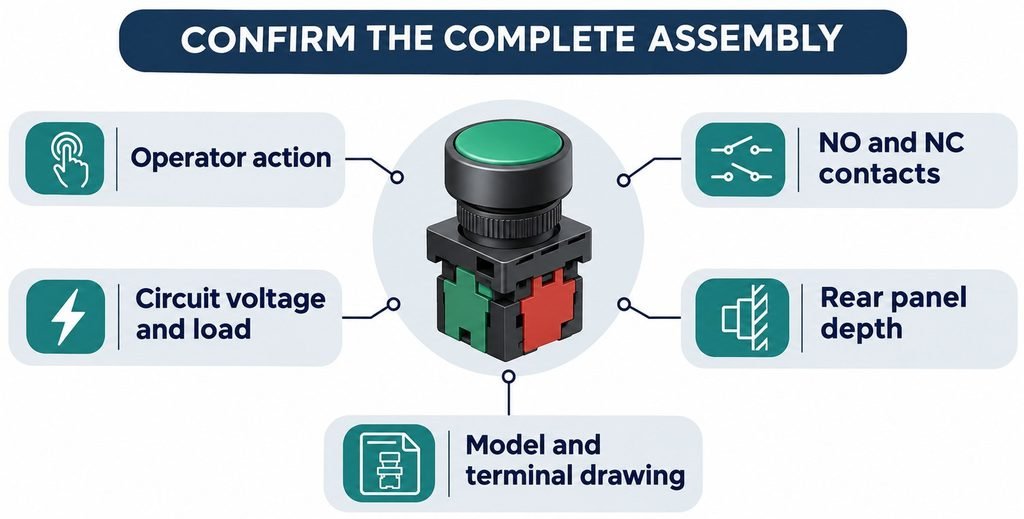
The final purchasing unit is more than an operator head plus a contact count. It includes the operator action, contact blocks, mounting parts and, where applicable, the lamp arrangement. Review these elements together because one change can affect the others.
For example, adding an extra control circuit may require another contact element and more rear clearance. Changing from a non-illuminated to an illuminated operator introduces a separate lamp specification and additional terminals. Changing from momentary to maintained operation changes how the control behaves even if the visible head remains similar. None of these differences should be hidden inside a short description such as “22 mm green button.”
The quotation should therefore identify the complete proposed configuration. Compare that description with the electrical schematic and panel layout. If a quotation lists only a series name, request the complete code and supporting drawing before approval.
Plan for Assembly and Maintenance
Contact blocks also affect how the panel will be assembled and serviced. The installer needs enough access to identify terminals, route conductors and tighten the specified connection. Maintenance staff need to understand which block serves each circuit and how a replacement should be matched.
Use durable wire identification and keep the terminal references consistent with the drawing. If the equipment will be built repeatedly, freeze the approved contact arrangement in the bill of materials. A later substitution should be reviewed as a configuration change, even when the replacement fits the same mounting hole.
For service planning, record the normal state and purpose of each contact. “Left block, stop circuit, NC” is more useful than “contact block 1” when technicians investigate a fault. This information reduces the risk that a replacement block is installed in the wrong position or connected to the wrong circuit.
Conceptual procurement checklist; not a product test or terminal drawing.
Frequently Asked Questions
Does 1NO1NC mean the same thing as two independent NO contacts?
No. A 1NO1NC arrangement contains one normally open contact and one normally closed contact. A 2NO arrangement contains two normally open contacts. The required arrangement depends on the control logic.
Does adding contact blocks change the front panel cutout?
The LA36A series is described as using a 22 mm mounting dimension, but additional switching elements can affect the depth and space required behind the panel. Request the drawing for the complete selected assembly.
Can any contact combination shown in the model table be ordered?
Not necessarily. The LA36A page states that the code table is for model explanation and that some combinations do not correspond to actual products. Ask YIJIA to confirm the complete model.
Is a maintained button defined by its NO or NC contact?
No. Maintained or momentary describes the operator action. NO or NC describes the contact’s normal electrical state. Both must be specified.
Should a push button switch a load directly?
That depends on the exact product rating, voltage, load type and circuit design. Provide the intended electrical duty and confirm the applicable rating. An interface relay may be appropriate when the operator should only carry a control signal.
Discuss Your Requirements
When requesting an LA36 push button, send the control function, required contact states, circuit voltage, load type, illumination requirement, available panel depth and quantity. YIJIA can then confirm an available configuration and provide the corresponding product information.
Installation dimensions: φ16MM 、φ19MM、 φ22MMCurrent: 5A/10A/15A/18AOperation: momentary / latching-cabinet latchIP degree: lP65 (waterproof industrial push button switch)The shell material: brass clad Chromium/stainless steel Want to know more about the product: Metal Push Button Switch Metal button switch LED indicator light power on effect diagram. LED lights are available in red, green, blue, yellow, and white […]
Yijia Product Brochure.zip In the field of industrial production, the degree of automation is getting higher and higher, and industrial robots, as an important production tool, have been widely used in various industries. In order to meet the demanding control requirements of industrial robots, Yijia has introduced the LA39 series of push-button switches designed specifically […]
Yijia Product Brochure.zip In the field of industrial production, the degree of automation is getting higher and higher, and industrial robots, as an important production tool, have been widely used in various industries. In order to meet the demanding control requirements of industrial robots, Yijia has introduced the GQ16A series of push-button switches designed specifically […]
We use cookies to enhance your browsing experience, serve personalised ads or content, and analyse our traffic. By clicking "Accept All", you consent to our use of cookies.