Limit switches may be small, but in industrial automation they play an outsized role. If you have ever wondered how heavy machinery knows when to stop, when to change direction, or how far a component can travel without damage, limit switches are often the silent heroes behind those decisions.
In modern factories—where uptime, precision, and worker safety are non-negotiable—limit switches help engineers stabilize processes, protect equipment, and maintain consistent product quality. Today, B2B buyers consider them essential components in automated production lines, CNC machines, conveyor systems, packaging equipment, and countless other industrial machines.
In this blog, we will explore the core function of limit switches, how they work, and why industrial customers rely on them for reliable and repeatable automation performance. More to help you evaluate the right solution for your application. If you need professional advice or a quote, you are welcome to contact our engineering team anytime.

Understanding the Main Function of a Limit Switch
At its core, the main function of a limit switch in industrial automation is simple: to detect the presence, position, or movement of a machine component and trigger a pre-defined electrical response.
This could be stopping a motor, opening a safety interlock, reversing a conveyor belt, or sending a signal to the PLC. Even though the mechanism is straightforward, the benefits are significant: consistent performance, increased safety, and reduced mechanical wear.
Typical Actions Triggered by a Limit Switch
Here is a practical comparison of common operations:
| Action Triggered | Typical Industrial Scenario | Benefit |
|---|---|---|
| Motor stop | A robotic arm reaches the end of travel | Prevents collision and overheating |
| Direction reversal | Conveyor line end detection | Smooth workflow without manual input |
| Safety shutoff | Guard door opens | Protects workers and meets CE/UL standards |
| Signal feedback | Machine position confirmation | Enhances PLC precision control |
Because limit switches operate mechanically, they offer high repeatability, low failure rates, and stable performance in harsh environments, making them especially popular in heavy-duty applications such as steel mills, mining equipment, and automated assembly lines.
How a Limit Switch Works in Automated Systems
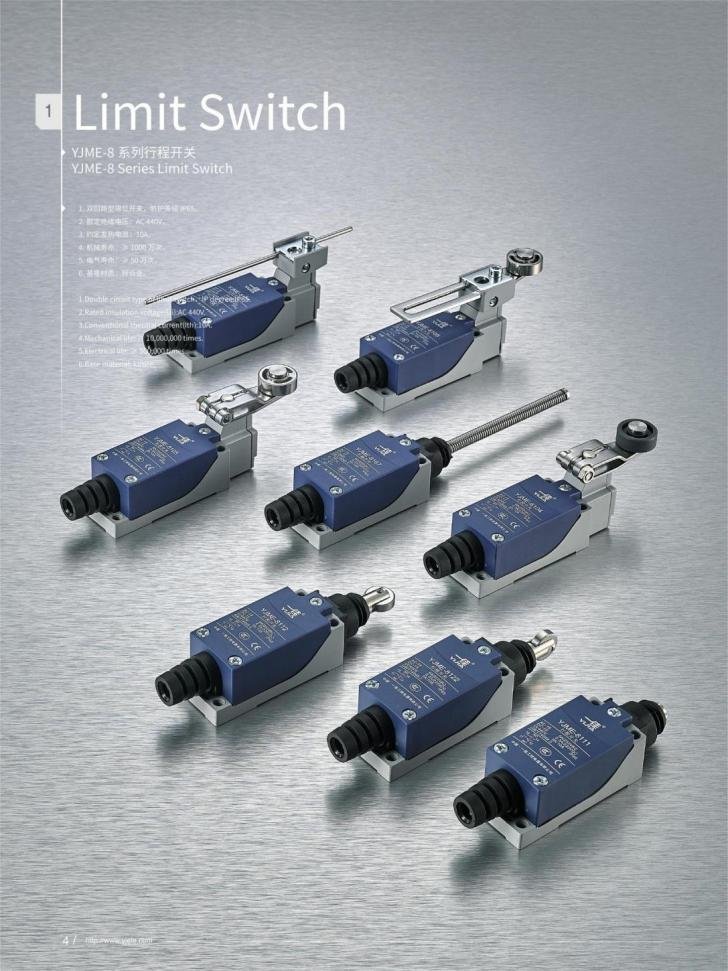
A limit switch is based on a mechanical actuator—such as a roller lever, plunger, or whisker—that physically interacts with a moving object. When this actuator is pressed or released, the internal contacts change state. This simple motion is what allows a limit switch to provide highly reliable position sensing without complex electronics.
Internal Working Principle
| Component | Function |
|---|---|
| Actuator (lever, plunger, roller) | Performs mechanical sensing |
| Contact block | Opens or closes electrical circuits |
| Housing | Protects internal components from dust, oil, and vibration |
| Terminal block | Connects the switch to the control system |
Because of this structure, limit switches are often selected for industrial environments that would damage optical sensors or proximity sensors.
Why Limit Switches Matter in Industrial Automation
You may ask: with so many modern sensors available—photoelectric, inductive, ultrasonic—why do factories still depend so heavily on limit switches?
The answer lies in their mechanical certainty.
They touch the object, they sense it, and they verify its exact position—every single time.
Key Advantages That Matter to B2B Buyers
| Advantage | Description | Ideal Use Case |
|---|---|---|
| Durability | Withstands vibration, heavy shock, dust, and oil | Metal forming, injection molding machines |
| Precision | Provides repeatable and stable switching points | CNC and robotics |
| Simplicity | No calibration required | Mass-produced machinery |
| Safety compliance | Excellent for interlock systems | Food, pharmaceutical, and chemical plants |
| Cost efficiency | Long life cycle and low maintenance | OEM production lines |
Factories choose limit switches because they are predictable, consistent, and rugged. In short, they work exactly as expected.
Key Types of Limit Switches Used in Industrial Automation
Choosing the right limit switch isn’t always easy. Different applications require different actuators, protection ratings, mounting structures, and electrical configurations.
Here’s a structured overview to guide your selection.
Common Industrial Limit Switch Types
| Type of Limit Switch | Characteristics | Typical Application |
|---|---|---|
| Rotary lever limit switch | Uses a roller arm; ideal for sliding or rotating motion | Conveyor position detection |
| Plunger limit switch | High accuracy; good for linear movement | CNC travel control |
| Micro limit switch | Compact, sensitive | Small automation devices |
| Heavy-duty limit switch | Large housing, high IP rating | Steel mills, mining plants |
| Safety interlock limit switch | Used on machine guards | Worker protection |
| IP67 waterproof limit switch | Dust-tight and immersion-resistant | Outdoor automation, washdown areas |
This classification helps B2B purchasers compare performance across multiple categories, especially when evaluating replacements or specifying components for new equipment.
Applications of Limit Switches Across Industries
Limit switches are everywhere in industrial environments. They help detect travel limits, confirm mechanical positions, and prevent accidents.
Where You Commonly See Them
| Industry | Application | Benefit |
|---|---|---|
| Packaging machinery | Detect carton presence | Smooth continuous packaging |
| Robotics | End-of-axis detection | Protects expensive servo systems |
| Elevators | Door interlocks | Safety compliance |
| Logistics and conveyors | Diverting and sorting systems | Fast and responsive movement |
| Automotive manufacturing | Assembly jigs and fixtures | High reliability |
| Metal fabrication | Press machines | Impact protection |
Need help selecting the right model for your industry? Our technical engineers can recommend compatible limit switch solutions based on your machine specifications. Send us your requirements anytime.
How to Select the Right Limit Switch for Your Machinery
Now that you understand what a limit switch does, let’s discuss how to choose the right one. A limit switch that works perfectly in one application may fail rapidly in another. Environment, electrical load, and mechanical movement all play major roles.
Important Selection Criteria
| Selection Factor | What It Means | Why It Matters |
|---|---|---|
| Operating environment | Dust, oil, water, vibration | Ensures long product life |
| Actuator type | Roller, lever, plunger | Matches your mechanical motion |
| Electrical rating | AC/DC compatibility and load capacity | Prevents contact damage |
| Mounting style | Side mount, top mount, adjustable | Ensures correct alignment |
| Travel distance | Pre-travel, over-travel | Affects precision |
| Standards and approvals | CE, UL, RoHS | Required for global manufacturing |
A well-matched limit switch reduces downtime and maintenance costs. If you are an OEM purchasing in bulk, this can significantly improve long-term operational efficiency.
Limit Switches vs. Proximity Sensors: Which Should You Use?
Many customers compare limit switches with inductive, capacitive, or optical sensors. Both have value, but they serve different roles.
| Feature | Limit Switch | Proximity Sensor |
|---|---|---|
| Contact type | Mechanical | Non-contact |
| Durability | Excellent in harsh environments | Sensitive to oils, dust |
| Accuracy | High mechanical repeatability | High but dependent on environment |
| Cost | Lower | Medium to higher |
| Maintenance | Occasional mechanical replacement | Minimal |
| Best for | Position and end-of-travel detection | Distance or object presence detection |
If your system involves high impact, heavy loads, or unpredictable environmental conditions, a limit switch is still the most reliable option.
If you need help comparing the two for your project, feel free to contact us for a customized evaluation.
Installation Tips for Long-Term Stability
Even the best limit switch can underperform if installed incorrectly. Here’s what engineers usually consider during installation:
| Consideration | Recommendation |
|---|---|
| Alignment | Ensure actuator meets the moving part squarely |
| Mounting position | Avoid excessive side load or misalignment |
| Cable routing | Keep wires away from stress points |
| Environment | Use IP67 or heavy-duty models for harsh conditions |
| Maintenance | Periodically inspect actuator wear |
Correct installation improves both accuracy and service life.
In industrial automation, limit switches remain one of the most dependable and widely used sensing components. Their main function—detecting position and controlling machine movement—makes them critical for safety, reliability, and efficiency. Whether your application requires a waterproof IP67 limit switch, a heavy-duty model for metal processing, or a high-precision plunger switch for CNC equipment, choosing the right product ensures stable operation and reduced downtime.
If your company needs industrial-grade limit switches or OEM customization, our engineering team is ready to assist. Send us your specifications and let us help you select the ideal model for your production line.
FAQ
To detect position or movement and trigger a control response.
Yes. Heavy-duty and IP67 limit switches perform reliably under dust, oil, vibration, and moisture.
Yes. Many are designed for machine guard interlocks.
Roller lever, adjustable arm, and high-IP-rated models are common choices.
Match it to your machine motion—linear, rotating, or sliding.
Yes, if contact detection is acceptable and you need higher durability in rough conditions.