AC relay switches are the “traffic controllers” of your AC power circuits, helping you switch, isolate, and protect loads safely and efficiently in industrial systems. For B2B buyers, choosing the right type of AC relay switch directly affects equipment reliability, downtime, and total cost of ownership. This guide walks through the main types of AC relay switches, where to use them, and what to check before you place your next order or RFQ.
What is an AC Relay Switch?
An AC relay switch is an electrically operated switch that uses a small control signal to turn an AC load on or off. It lets you isolate low‑voltage control electronics from higher‑voltage AC circuits while safely switching motors, heaters, lighting, compressors, and more.
In practice, AC relay switches are widely used in:
- Industrial automation and PLC control panels.
- HVAC systems for compressors, blowers, and pumps.
- Home and commercial appliances such as ovens, chillers, and washing machines.
Because a relay separates the control circuit from the load circuit, it improves safety and makes maintenance easier. For OEMs and panel builders, the right relay choice is also a selling point for reliability and compliance.

Main Types of AC Relay Switches
There are three broad categories you will meet most often when you search for “AC relay switches” in industrial applications. Each has its own strengths, limitations, and typical use cases.
Electromagnetic AC Relay Switches
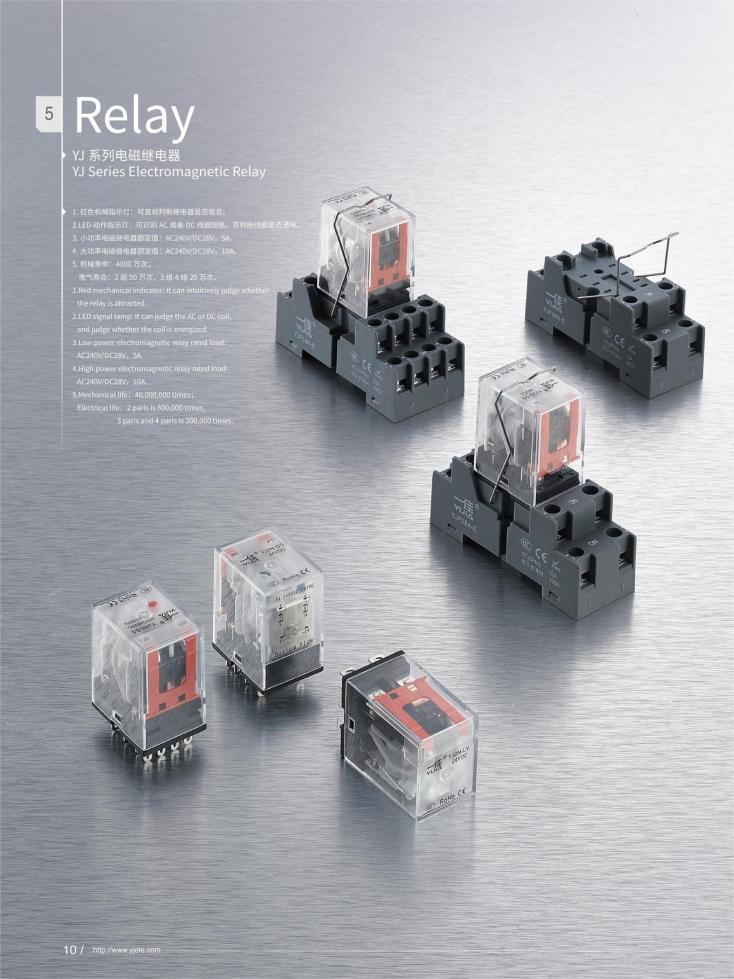
Electromagnetic relays (EMR) use a coil, armature, and mechanical contacts to switch AC loads. When the coil is energized, the contacts change state (NO closes, NC opens) and connect or disconnect the AC circuit.
Key points:
- Common in general‑purpose AC control, signal switching, and small motor loads.
- Available as plug‑in “cube” relays, slim DIN‑rail relays, and PCB relays.
- Easy to understand, test, and replace, which maintenance teams appreciate.
Solid State AC Relay Switches
Solid state relays (SSR) use semiconductor devices instead of mechanical contacts to switch AC loads. Because they have no moving parts, they offer silent operation, high switching speed, and long electrical life.
Typical advantages:
- No contact arcing, no contact bounce, and very low EMI when designed correctly.
- Ideal for high‑frequency switching, precise temperature control, and sensitive environments.
- Often used in AC motor control, heating control (furnaces, ovens), and CNC machines.
Hybrid and Power Relays
Hybrid relays combine a solid state stage for switching and a mechanical contact for conduction, aiming to balance low wear with low losses. Power relays are robust electromagnetic relays designed to switch higher AC currents for pumps, fans, compressors, and other medium‑power loads.
These are popular in:
- Industrial power distribution and machine control.
- HVAC systems and heavy home appliances.
- Automotive and transportation electronics when AC loads are involved.
Common AC Relay Switch Types and Uses
If you already know your load type and current, you can quickly narrow down which category of AC relay switch you need.
How AC Relay Switches Work in AC Circuits
From a control perspective, all relay switches follow the same basic logic: a small control input drives a much larger AC load. For B2B buyers who design panels or machines, understanding this logic helps you specify the right coil voltage, contact arrangement, and protection.
Control Side vs Load Side
On the control side, a PLC output, thermostat, float switch, or microcontroller sends a low‑power signal to the relay coil (or input terminals for SSRs). On the load side, the relay’s contacts or semiconductor devices connect or disconnect the AC power going to the equipment.
This separation gives you:
- Electrical isolation between control and power circuits.
- Flexibility to mix low‑voltage controls with higher‑voltage AC loads.
- Easier troubleshooting, because the relay is the defined interface point.
NO/NC Contacts and Poles
Most AC relay switches offer normally open (NO) and normally closed (NC) contacts, plus different pole configurations (SPST, SPDT, DPDT, etc.). For example, a 2‑pole AC relay can simultaneously switch both line and neutral, improving safety and compliance in many regions.
Solid state relays typically behave like a normally open device that closes when the input is active, while multi‑pole mechanical relays give you greater flexibility for interlocking and feedback circuits. When you send your RFQ, make sure your supplier clearly understands how many poles and which contact forms your application requires.
Basic Operating Features
Once you map these features to your project requirements, it becomes much easier to justify your relay selection to internal stakeholders.
Key Applications of AC Relay Switches
AC relay switches show up almost everywhere in modern electrical systems, from small appliances to large industrial plants. Below are some of the most common “high‑intent” application areas that also align with popular long‑tail search terms.
Industrial Automation and Motor Control
In industrial automation, AC relay switches handle tasks like motor start/stop, safety interlocks, and load shedding. While larger motors use contactors, relays still play a major role in auxiliary circuits, small pumps, conveyors, and fans.
Typical uses include:
- On/off control of small AC motors, fans, and conveyors.
- Switching solenoid valves and actuators in process lines.
- Isolating PLC outputs from noisy AC loads.
Solid state AC relay switches are especially attractive for precision motor speed or torque control where frequent switching is required. If your plant is pushing for predictive maintenance and higher uptime, upgrading to SSR‑based solutions in critical loops can be a smart step.
HVAC Systems and Building Services
HVAC is one of the biggest markets for AC relay switches, particularly solid state relays in modern systems. They control compressors, fan motors, expansion valves, heating elements, and circulation pumps.
Benefits in HVAC applications:
- Smooth, frequent switching for temperature and airflow control.
- Quiet operation in residential and commercial buildings.
- Improved energy efficiency by enabling finer control strategies.
Many OEMs now advertise “solid state relay HVAC control” and “smart AC relay switch for heat pump” as key selling points in their catalogs. If you are designing or sourcing HVAC control panels, relay selection has a direct impact on performance and perceived quality.
Home and Commercial Appliances
In appliances, AC relay switches provide safe on/off control for heaters, compressors, and motors. Power relays are common in:
- Ovens and electric cookers for heating elements.
- Refrigerators and freezers for compressor control.
- Washing machines and dishwashers for pumps and motors.
Because these devices typically switch inductive loads, you must pay attention to contact ratings, inrush current, and surge protection when selecting an appliance‑grade AC relay switch. This is where working with an experienced relay manufacturer can help you avoid expensive redesigns and field failures.
Typical AC Relay Switch Applications
If any of these application scenarios match your products or projects, it may be time to refine your AC relay switch specification—and get a competitive quote.
Selecting the Right AC Relay Switch for Your Project
Now the key question: how do you choose the best AC relay switch for your specific project? Several technical and commercial factors should guide your decision.
Electrical Ratings and Load Type
First, define the electrical characteristics of the load:
- AC voltage and nominal current.
- Load type: resistive (heaters), inductive (motors, transformers), or capacitive.
- Starting current or inrush, especially for motors and transformers.
Relays are typically used up to about 10 A at 250 V AC, while contactors are chosen for higher currents and heavy three‑phase loads. Solid state relays can handle high AC currents as long as they are correctly heatsinked and mounted.
Control Voltage, Isolation, and Safety
Next, match the control side to your system:
- Coil or input voltage (e.g., 5 V, 12 V, 24 V DC, or 110/230 V AC).
- Required isolation level between control and load circuits.
- Applicable safety standards or approvals (UL, CE, IEC, RoHS, etc.).
Good isolation is essential in PLC and microcontroller systems, and solid state relays with optocouplers are often used when high isolation and noise immunity are required. For export projects, having the right certifications on your AC relay switch can significantly speed up compliance.
Mechanical and Environmental Considerations
Finally, consider the mechanical integration:
- Mounting type: DIN‑rail, panel‑mount, PCB, or plug‑in socket.
- Ambient temperature, vibration, and humidity levels.
- Required switching frequency and expected lifetime.
For example, a “compact DIN‑rail AC relay switch for control panel” is a typical long‑tail requirement in OEM and system‑integrator markets. If your environment is harsh or switching is frequent, an SSR or hybrid relay is usually more reliable than a standard mechanical relay.
Key Selection Criteria at a Glance
If you share these parameters with your relay supplier, they can quickly recommend the most suitable AC relay switch and propose cost‑effective alternatives.
AC Relay Switches vs Contactors vs Simple Switches
Many buyers ask whether they really need a relay, or if a contactor or manual switch would do the job. The answer depends on load size, control method, and safety needs.
- Use a simple mechanical switch for low‑power, manual on/off where no remote control is required.
- Use an AC relay switch for automatic or remote switching of low to medium‑power loads.
- Use a contactor for high‑power, three‑phase or heavy inductive loads like large motors and compressors.
Because relays and contactors both have NO/NC contacts, it is easy to confuse them, but contactors are physically larger and designed for much higher current and voltage. In short, relays are for control‑level AC switching; contactors are for main‑power switching.
For B2B buyers, AC relay switches are more than just small components—they are key to safety, uptime, and customer satisfaction across industrial automation, HVAC, and appliance projects. Understanding the differences between electromagnetic, solid state, hybrid, and power AC relay switches helps you choose the right product, avoid failures, and optimize your total cost of ownership.
If you are planning a new control panel, upgrading an existing machine, or developing an OEM appliance, now is a great time to review your AC relay switch specification and discuss it with a reliable manufacturer or supplier. Share your load data, control voltage, and environment, and you can quickly get a tailored AC relay switch solution—and a competitive quotation for your next production order.
FAQ
An AC relay switch is used to control AC loads—such as motors, heaters, pumps, and lighting—using a low‑power control signal from a PLC, thermostat, or controller.
AC relays are designed to operate with AC coil voltage and to switch AC loads, while DC relays use DC coils and are optimized for DC load switching. Their internal construction differs to handle the characteristics of AC and DC magnetic circuits and arcing.
Choose a solid state AC relay switch when you need silent operation, high switching frequency, long lifetime, or precise control, for example in temperature control, CNC machines, and modern HVAC systems.
In general, an AC relay switch should not replace a contactor for high‑power loads, because relays are typically rated for lower current and are not designed for heavy motor starting duty.
You size an AC relay switch by checking the load voltage, steady‑state current, inrush current, load type, and safety margins or derating recommended by the manufacturer. If in doubt, many engineers choose a relay with a higher current rating to improve reliability.
Yes, AC solid state relays are safe when installed correctly with appropriate heat sinking, fusing, and insulation; they also offer the advantage of no contact arcing.