Limit switches may be small components in industrial systems, but they play a big role in ensuring precision, safety, and automation reliability. Whether you’re running a large manufacturing line, designing material-handling equipment, or integrating IoT-enabled control systems, choosing the right limit switch can dramatically improve performance and reduce maintenance costs.
In this guide, we’ll take a deep dive into what limit switches are, their main types, how they compare, and what you should consider before selecting one for your industrial or automation project. Let’s get started!
What Is a Limit Switch?
A limit switch is an electromechanical device that detects the physical presence or movement of an object using mechanical actuation. Once triggered, it either opens or closes an electrical circuit, sending a signal to the control system. This signal can be used for many purposes such as:
- Stopping a motor when an object reaches a certain position
- Controlling the travel limits of industrial machinery
- Providing safety interlocks in production lines
- Counting parts or detecting obstructions in palletizing systems
You’ll often find limit switches in CNC machinery, elevators, conveyors, packaging equipment, and assembly lines. In short, limit switches help guarantee precision and safety, both vital in today’s automated manufacturing environments.

How Does a Limit Switch Work?
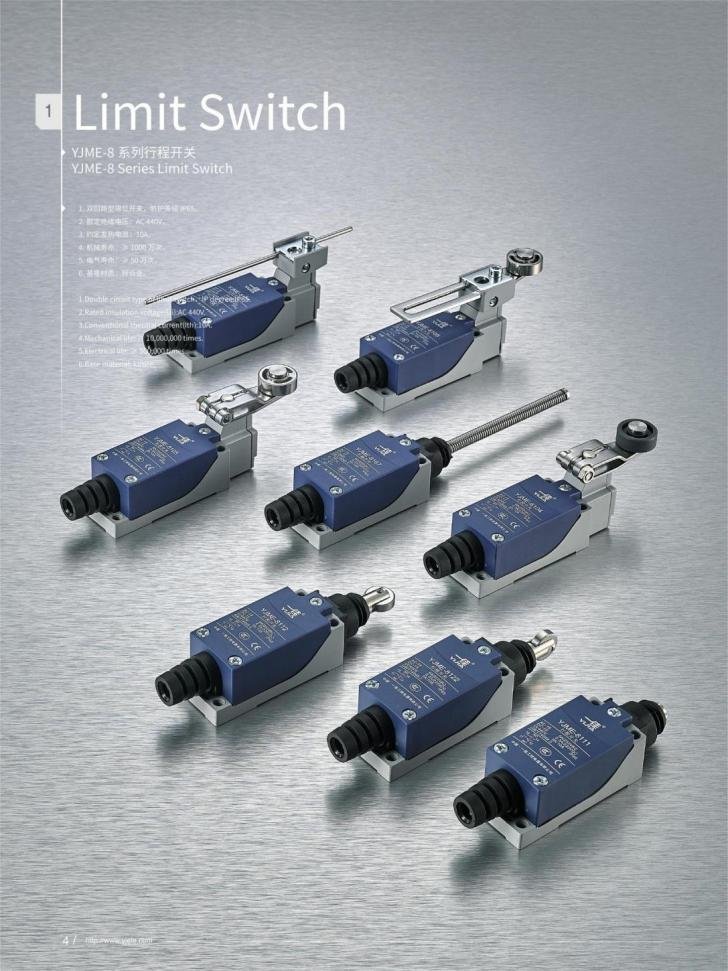
A typical limit switch includes an actuator, contacts, housing, and a mechanical lever or plunger. When an object comes into contact with the actuator, it generates motion inside the switch mechanism, changing the state of the contacts. The resulting electrical signal tells the control circuit that a specific mechanical position has been reached.
In modern automation, many smart control systems use limit switches as part of their feedback loops. This ensures not only accurate mechanical stopping but also real-time data for preventive maintenance—a rising trend in Industry 4.0.
Main Types of Limit Switches
There are several designs of limit switches, each suited for specific industrial applications. Let’s look at the most widely used types and compare their performance.
| Type | Actuation Mechanism | Typical Application | Key Advantages |
|---|---|---|---|
| Mechanical Limit Switch | Lever, roller, or plunger contact | Machinery with physical position detection | Durable, cost-effective, easy replacement |
| Proximity Limit Switch | Magnetic, inductive, or capacitive sensing | Non-contact detection of metals or plastics | High accuracy, long lifespan, no wear |
| Rotary Limit Switch | Rotational motion detection | Control of hoists, cranes, wind turbines | Suitable for large equipment, adjustable settings |
| Optical Limit Switch | Light beam interruption | High-speed production lines | Fast response, no mechanical wear |
| Safety Limit Switch | Mechanical with safety-rated contacts | Emergency stops, safety doors | Compliant with safety standards, reliable shut-off |
Understanding these variations helps engineers and procurement managers choose the most suitable switch for their technical needs and operational environments.
Mechanical Limit Switches – The Classic Workhorse
Mechanical limit switches remain one of the most reliable solutions in heavy-duty automation. Their direct-contact operation makes them inexpensive, robust, and simple to integrate into older systems.
They often include spring-loaded levers or plungers that detect mechanical movement. Even though they may suffer from mechanical wear over time, their high current capacity and resistance to electrical noise make them ideal for industrial machinery, presses, and elevators.
If you’re running a production line where durability and affordability matter most, mechanical designs are still a top choice.
Non-Contact Proximity Limit Switches
Unlike mechanical models, proximity limit switches use magnetic, inductive, or capacitive fields to detect the presence of objects without direct contact. This eliminates wear and extends service life.
Common types include:
- Inductive proximity limit switches: Ideal for detecting metal objects in harsh environments.
- Capacitive proximity switches: Detect non-metallic materials like plastics, liquids, and powders.
- Magnetic Reed limit switches: Used in cylinders or pneumatic systems where precise non-contact detection is required.
This group of switches is perfect for high-performance automation systems requiring longevity, cleanliness, and speed — such as in food processing or packaging industries.
Pro tip: Always check the sensing distance and output type (PNP/NPN or relay) when integrating proximity types with a PLC (Programmable Logic Controller).
Rotary Limit Switches – Precision in Motion
Rotary limit switches are specifically designed for equipment with rotational motion, such as cranes, hoists, elevators, and wind turbines. They monitor the number of rotations or shaft movement to determine position limits.
These switches feature adjustable cams or gears that trigger electrical contacts at precise shaft angles. Their strengths lie in customizable control range, rugged enclosures, and excellent repeatability.
They are an excellent choice for B2B buyers dealing with heavy-lift machinery or energy-sector equipment manufacturers seeking high mechanical accuracy and configurable control.
Optical Limit Switches – Fast and Clean Detection
Optical limit switches operate on the principle of light beam interruption. When an object breaks the beam between the emitter and receiver, the circuit changes state.
Their non-contact nature and instant response time make them invaluable in high-speed production lines, robotic arms, and semiconductor manufacturing.
Although they are more sensitive to environmental conditions like dust or moisture, optical switches are unbeatable for cleanroom or precision-based applications.
If your company works in automation integration or robotics OEM, optical models offer cutting-edge detection precision.
Safety Limit Switches – For Industrial Protection
Safety limit switches serve a dual purpose: mechanical detection and safety interlock. They are engineered according to ISO 13849-1 and IEC 60947-5-1 safety standards, ensuring compliance in machine safety systems.
They are commonly found on safety doors, emergency stop panels, and press control systems. Features often include positive-opening contacts and tamper-proof housings.
This makes them critical for applications where worker safety, equipment protection, and regulatory compliance are top priorities.
Choosing the Right Limit Switch for Your Application
When selecting a limit switch for your industrial operation, pay attention to the following factors:
- Operating Environment: Dust, temperature, humidity, and vibration can affect performance.
- Load Type and Current Rating: Ensure compatibility with your control circuit.
- Mounting Configuration: Choose between panel mount, roller lever, plunger, or rotary shaft types.
- Switching Speed: Critical in high-speed conveyor or packaging applications.
- Compliance Certification: Always check for CE, UL, or ISO certifications for export projects.
| Selection Factor | Recommended Switch Type | Notable Advantage |
|---|---|---|
| Dusty or dirty environment | Inductive proximity switch | No contact, sealed design |
| Heavy mechanical load | Mechanical limit switch | High current tolerance |
| Safety-critical system | Safety limit switch | Fail-safe operation |
| High-speed line | Optical limit switch | Instant response |
| Rotary motion equipment | Rotary limit switch | Adjustable range control |
If you need help specifying the right model for your production line, feel free to contact our technical sales team or send an inquiry today. We’ll help you find the perfect match for your automation system.
Smart Limit Switches in Industry 4.0
As manufacturing moves toward smart factories, traditional limit switches are getting smarter too. Connected sensors now integrate with IoT (Internet of Things) networks, allowing for:
- Real-time monitoring of switch condition and actuation frequency.
- Predictive maintenance alerts before mechanical failure.
- Integration with PLC and cloud-based dashboards for process analytics.
If your company is working on machine upgrades or digitized production equipment, smart limit switches can provide valuable data to optimize downtime and productivity.
Common Limit Switch Applications
- CNC machine tool position control
- Elevator and hoist operation limits
- Automated packaging lines
- Industrial robots and pick-and-place systems
- Safety interlocks in production cells
Each of these use cases benefits from the accuracy and dependability that limit switches provide.
Limit switches may be small, but they make automation smarter, safer, and more reliable. From mechanical limit switches in heavy-duty equipment to optical or proximity sensors in high-speed manufacturing, the right choice ensures seamless operation and prevents costly downtime.
For B2B buyers and industrial integrators, understanding these technologies can also mean reduced maintenance costs, increased line efficiency, and a competitive advantage in precision control.
If you’re currently evaluating limit switch options for your facility or OEM equipment, reach out to our sales engineers today to discover high-quality, custom solutions tailored to your industry’s needs.
FAQ
Limit switches are digital in nature—they operate in ON/OFF states based on the physical contact or sensor detection.
Mechanical switches can last millions of cycles, while non-contact designs often exceed that due to no mechanical wear.
Yes, but always choose models with IP-rated enclosures to protect against moisture and dust.
Yes, some modern designs integrate wireless connectivity for remote monitoring within industrial IoT systems.
That depends on your mechanical setup and environmental conditions. You can share your equipment details, and our engineering team will recommend a suitable model.