If you’ve ever had an AC unit that “almost” starts—fan twitches, compressor hums, then nothing—you already know how a small switching component can create a very big service ticket. In commercial HVAC, that pain multiplies: downtime affects tenants, production lines, cold rooms, and SLAs. That’s why choosing the right relay switch in AC unit applications is not a minor detail—it’s a reliability decision that procurement teams and engineers own together.
This article is written for B2B buyers, wholesalers, OEMs, and design engineers who want fewer surprises: clearer specs, smarter sourcing, and smoother replacements. Along the way, we’ll also weave in common long-tail searches (like “24V relay in air conditioner” and “AC compressor relay replacement”) and procurement language (like manufacturers, suppliers, wholesale prices, customization, and OEM/ODM) without turning this into a catalog page.
Where a Relay Switch Fits in an AC Unit Control Chain
In most HVAC systems, the control side is intentionally “small” (low voltage, low current) while the load side is “big” (motors, compressors, heaters). The relay is the bridge—allowing a control signal to switch a higher-power circuit safely and repeatedly.
In a typical split system or packaged unit, the thermostat or controller calls for cooling. That signal goes to a control board, which energizes a relay (or drives a contactor coil). The relay’s contacts then switch a load directly (e.g., indoor fan) or indirectly (e.g., energize a contactor that powers the compressor).
Procurement takeaway: the relay’s job in an AC unit is rarely “generic on/off.” It’s usually switching an inductive load (motors/solenoids) with startup surges, heat, vibration, and sometimes outdoor moisture. Buying “the cheapest equivalent” can work—until it doesn’t.
| Control-chain element | Typical role | Typical electrical side | What buyers should verify |
|---|---|---|---|
| Thermostat / BMS output | Issues cooling/heating call | Low-power signal | Output type (dry contact vs powered), voltage level |
| Control PCB | Logic + protections + timing | Low voltage | Relay drive method, surge protection, diagnostics |
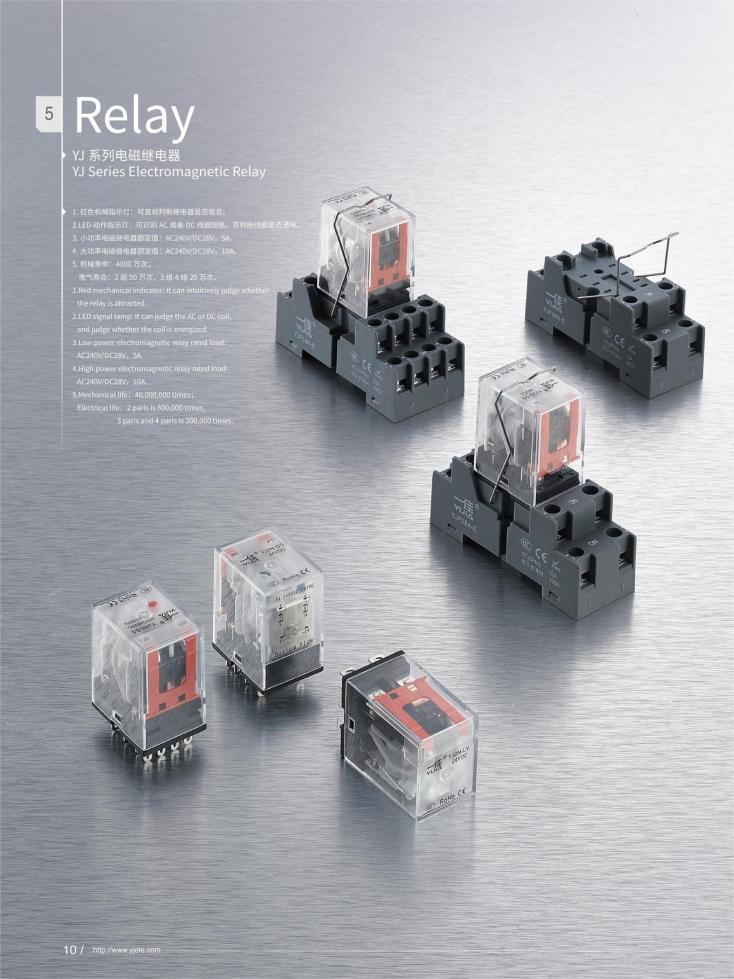
| Relay (general-purpose) | Switches moderate loads | Coil + contacts | Coil voltage, contact rating, form factor, approvals |
| Contactor | Switches high-current loads | Coil + power contacts | AC duty rating, coil compatibility, auxiliary contacts |
| Compressor / fan motor | Main inductive loads | High current | Inrush/start method, LRA, cycling frequency |

Relay vs Contactor vs Solid-State Relay: Choosing the Right Switching Element
People sometimes use “relay” as a catch-all, but HVAC design usually separates switching devices by duty and current:
- Electromechanical relay (EMR): Great for control logic and moderate loads, common on PCBs.
- Contactor: Built for higher current and frequent motor switching; common for compressors.
- Solid-state relay (SSR): No moving parts; useful when silent operation and very high cycle life matter, but it brings heat dissipation and leakage current considerations.
The correct choice depends on the load (motor vs resistive), switching frequency, environment, and service model (board swap vs field replacement). For example, an indoor fan relay on a control board may be EMR-based, while the compressor circuit is often contactor-based.
| Device type | Strengths in HVAC | Common pitfalls | Typical use cases |
|---|---|---|---|
| EMR (electromechanical) | Cost-effective, easy to source, clear isolation | Contact wear, arcing on inductive loads, coil sensitivity | Fan switching, valve control, auxiliary logic |
| Contactor | Handles high inrush and motor duty well | Larger size, audible noise, coil selection errors | Compressor, large blower motors, heaters |
| SSR | Silent, fast switching, high cycle count | Heat generation, leakage current, needs proper heatsink | High-frequency control, noise-sensitive applications |
If your RFQ says “relay switch in AC unit” but the application is a compressor with heavy start current, many engineers will interpret that as “verify whether this should be a contactor or a motor-rated relay.” That single clarification can prevent premature failures.
Engineering Specs That Actually Matter (and How to Read Them)
Datasheets can feel like they were written for someone else. Let’s translate the specs into procurement decisions you can act on.
Start with the three deal-breakers:
- Coil voltage and coil type (AC coil vs DC coil; tolerance range)
- Contact rating for the real load (especially inductive/motor loads)
- Mechanical fit (PCB footprint, terminal style, mounting method)
Then layer in reliability and compliance: ambient temperature, sealing, insulation system, approvals (UL/CE), and endurance under the expected duty cycle.
| Specification | Why it matters in AC units | What to request from suppliers/manufacturers |
|---|---|---|
| Coil voltage (e.g., 24V DC, 110V AC) | Wrong coil = chattering, overheating, or no actuation | Coil nominal + operating range, coil power, inrush/hold data |
| Contact form (SPST, SPDT, DPDT) | Determines wiring compatibility and control logic | Contact diagram, terminal numbering, NO/NC configuration |
| Contact rating (AC1/AC3, resistive vs motor) | Motor loads produce arcing and surges | Load category ratings, motor duty curves, derating guidance |
| Inrush capability | Fans/compressors can spike current at start | Inrush current rating, recommended snubber/RC networks |
| Ambient temp & enclosure | Outdoor units run hot and face moisture | Temperature range, sealing/IP rating, material specs |
| Mounting & terminals | Drives installation time and field service ease | Dimensions, CAD/footprint, terminal plating, torque spec |
| Compliance | Required for many B2B projects | UL/IEC files, RoHS/REACH, factory QC process, ISO certificates |
A common B2B mistake is comparing relays solely by “30A” on a label. That number may assume a resistive load. HVAC loads are often inductive, and the correct rating approach depends on the duty category and switching conditions. If you’re buying at scale, ask manufacturers for application-specific guidance instead of guessing.
Failure Modes in the Field and How to Prevent Them
Relays typically don’t fail “randomly.” They fail in patterns—and each pattern points back to a spec mismatch, installation detail, or environmental stress.
The classic HVAC relay failures include:
- Chattering/buzzing: coil voltage mismatch, unstable control voltage, or poor coil drive.
- Welded contacts: inductive arcing, underestimated inrush, insufficient contact material.
- Burnt coil: overheating, overvoltage, tight enclosures with poor airflow.
- Intermittent switching: vibration, contamination, oxidation, or marginal contact pressure.
If you’re managing warranty exposure or maintenance contracts, the goal is simple: turn field failures into predictable design choices.
| Symptom | Likely root cause | Quick verification | Prevention strategy |
|---|---|---|---|
| Relay clicks rapidly (chatter) | Coil voltage drop, wrong coil type (AC/DC), weak driver | Measure control voltage at coil during actuation | Match coil to control supply, add suppression, verify driver margin |
| Contacts welded closed | Inrush too high, inductive arcing | Inspect contact discoloration/weld marks | Use motor-rated device, add snubber/RC, select better contact alloy |
| Unit won’t start, relay silent | Coil open, PCB driver failure, no control signal | Coil resistance test; confirm command signal | Improve surge protection, validate coil tolerance, quality incoming inspection |
| Relay runs hot | Overcurrent, inadequate airflow, high ambient | Thermal scan under load | Derate for ambient, choose higher-rated part, improve enclosure design |
This is where “cheap now” becomes “expensive later.” If your procurement team is evaluated on unit price, consider reframing to lifecycle cost: service calls, downtime penalties, and warranty claims can dwarf a small component delta.
Replacement and Retrofit Considerations for Service Teams
For many buyers, the most urgent search isn’t “what is a relay,” it’s “what do I replace this with today?” That’s where cross-referencing matters.
When replacing a relay in an air conditioner, you must match more than coil voltage:
- Coil voltage and type (e.g., “24V relay in air conditioner” usually means 24V control, often DC on boards)
- Contact arrangement (NO/NC and pole count)
- Electrical rating for the load
- Footprint and terminals (PCB pin layout vs spade terminals vs plug-in base)
| Replacement checkpoint | What to match | What can vary (with engineering approval) | Notes for purchasing |
|---|---|---|---|
| Coil voltage/type | Must match | Coil power sometimes | Confirm DC vs AC coil—do not assume |
| Contact form | Must match | None | SPDT vs SPST changes wiring behavior |
| Contact rating | Must meet/exceed | Higher is usually acceptable | Ensure inductive/motor suitability |
| Footprint/terminals | Must match | Terminal plating sometimes | PCB relays are especially footprint-sensitive |
| Approvals | Often required | Extra approvals fine | Some projects need UL/CE documented parts |
If you manage spares, you can reduce SKU count by standardizing around a small set of relays with consistent footprints and ratings—but only after engineering confirms the load categories and switching conditions.
Buying for B2B: Supplier Qualification, Pricing, and Logistics
When sourcing relay switches for HVAC, the “right” supply chain depends on your business model:
- OEM/ODM manufacturers are best for customization, stable BOM control, and factory-direct pricing.
- Wholesalers/distributors are best for speed and mixed-SKU availability.
- Traders can fill gaps, but risk traceability and consistency—so use them carefully.
For procurement and engineering teams, supplier qualification should be systematic. You want stable process control, documented test methods, and predictable lead times—not just a low quote.
| Evaluation category | What “good” looks like | What to ask suppliers/manufacturers | Risk if ignored |
|---|---|---|---|
| Quality system | ISO-based controls, lot traceability | QC flow, AQL plan, trace codes | Inconsistent batches, difficult RMAs |
| Technical support | Fast datasheet + application guidance | Load validation, derating advice | Wrong part chosen, field failures |
| Compliance | Documented conformity | UL/CE files, RoHS/REACH declarations | Project approval delays |
| Pricing structure | Transparent tiers | MOQ, price breaks, tooling costs | Hidden costs, margin surprises |
| Logistics | Stable lead time, packaging control | Lead time, incoterms, packaging spec | Line stoppages, damage in transit |
If you’re comparing prices from multiple relay switch suppliers, insist that every quote includes: coil voltage/type, contact form, load category rating, approvals, packaging, MOQ, and lead time. Otherwise, you’re comparing apples to… something that looks like an apple.
A practical move: request pre-production samples and perform a small validation test under your real load. It’s inexpensive insurance before a bulk PO.
Customization Options for OEMs and Panel Builders
If you’re building control boards, assembling HVAC panels, or supplying branded spares, customization can be a competitive advantage—especially when you’re working with relay switch manufacturers who support OEM/ODM.
Common customization areas include:
- Coil voltage variants (to align with regional control standards)
- Terminal style changes (PCB pins vs quick-connect tabs)
- Branding and labeling (part numbers, traceability codes)
- Enhanced environmental protection (coatings, sealed housings)
- Packaging for production efficiency (tape/reel, trays, kitting)
| Customization request | Who benefits most | Typical impact on cost/lead time | Procurement note |
|---|---|---|---|
| Private label / logo marking | Distributors, OEM spares | Low–moderate | Confirm traceability stays intact |
| Terminal/footprint modification | OEM boards/panels | Moderate–high | Often needs tooling + validation |
| Higher-temp materials | Outdoor units, harsh sites | Moderate | Ask for material and temp documentation |
| Sealed or coated versions | Humid/corrosive environments | Moderate | Verify IP rating claims and test method |
| Packaging customization | High-volume lines | Low–moderate | Reduces handling damage and line time |
For many B2B teams, the best outcome is not the lowest per-unit cost—it’s fewer failures, fewer variants, and faster assembly. Customization can support all three when scoped properly.
A relay looks like a small part because it is a small part. But in HVAC systems, it sits right on the boundary between “command” and “power,” which means it gets blamed for everything—sometimes fairly.
If you take only one idea from this guide, make it this: define the load and the control conditions clearly, then source from suppliers who can document ratings, compliance, and consistency. That’s how you turn relay sourcing from a recurring problem into a stable line item—and how you keep service calls from becoming your most expensive “supplier.”
FAQ
Not always. Many units use a contactor for the compressor and relays for fans/valves/control.
Many systems use 24V control, but the relay coil may be DC or AC depending on the design. Verify, don’t assume.
Often yes electrically, but mechanical footprint and load category ratings must still match the application.
For inductive loads, suppression is frequently recommended to reduce arcing and extend contact life.
Manufacturers fit OEM volume and customization; wholesalers fit fast delivery and mixed SKUs. Many B2B teams use both.