Electrical control systems have a simple dream: let small signals command big power—safely, reliably, and for years. The reality is messier. Motors surge. Loads spark. Panels get hot. Operators press buttons at the worst possible time. And somehow, everything still needs to switch on and off like it’s no big deal.
That’s where the relay switch earns its place.
In industrial automation, HVAC, building controls, and general electrical panels, an AC relay switch is often the “quiet middleman.” A low-power control signal energizes a coil, and that action opens or closes contacts that handle higher voltage or current. It’s a small component with a very public job: when it fails, everyone notices.
This article explains what an AC relay switch does in electrical control, how engineers specify it, and how B2B buyers evaluate manufacturers, suppliers, wholesalers, prices, and customization—without turning your procurement process into a guessing game. I’ll keep the language direct, include practical tables in each section, and add a few long-tail terms your customers actually search for (like AC coil relay, electromechanical relay switch, and industrial relay for control panel).
What Is a Relay Switch, and Why AC Relays Still Matter
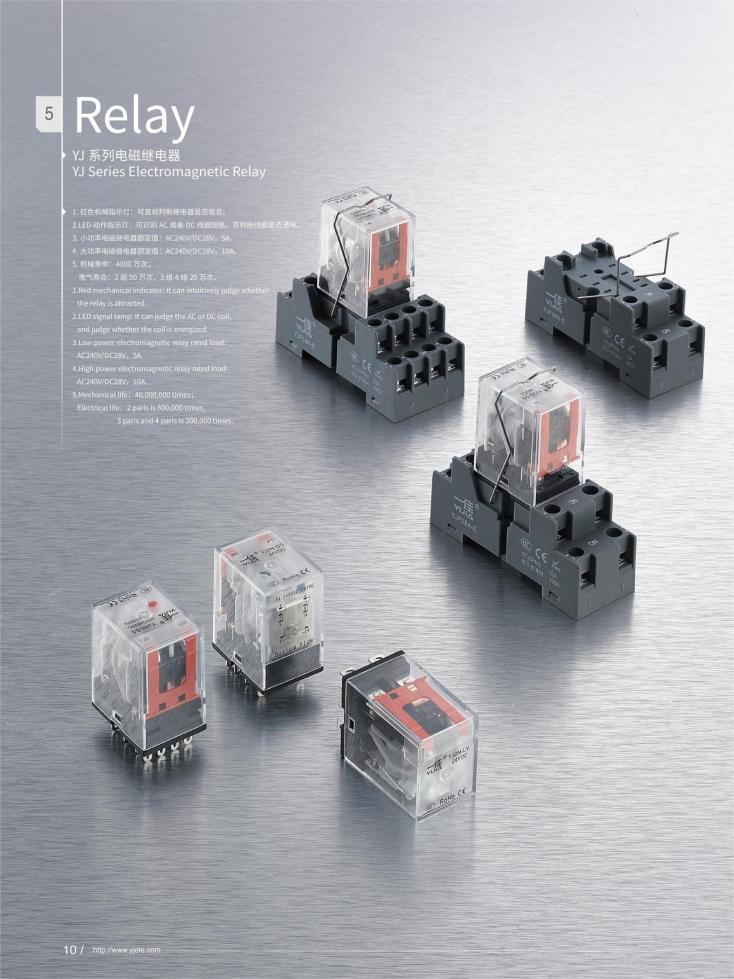
A relay switch is an electrically operated switch. It uses a coil (electromagnet) to move contacts. When the coil is energized, the relay changes state: normally-open contacts close, normally-closed contacts open, or both.
So why do AC relays still matter in modern control systems when we have PLC outputs, SSRs, and smart controllers?
Because electrical control is not just logic. It is also isolation, load handling, and safety. A relay provides a clear physical separation between control and power circuits. That is a big deal when a panel needs to withstand noise, surges, and harsh environments.
A common use case looks like this:
- A controller outputs a signal (often low voltage).
- That signal energizes an AC relay coil (or a relay driven by AC control power).
- The relay contacts switch a higher-power circuit—like a motor starter circuit, solenoid valve, heater, or alarm.
And yes, AC relays are still very common in industrial cabinets because many facilities already distribute AC control power (such as 110/120VAC or 220/240VAC) inside panels.
| Term | What it means | Why it matters in control systems |
|---|---|---|
| Relay coil (AC coil) | The energizing input side | Determines control voltage compatibility |
| Contacts | The load switching side | Determines what load types can be switched |
| NO / NC | Normally Open / Normally Closed | Defines default state and safety behavior |
| Pole / throw | Contact configuration (SPST, SPDT, DPDT) | Determines how many circuits you can control |
| Isolation | Separation between coil and contacts | Supports safety and noise immunity |
If you’ve ever joked that “it’s just a relay,” you already know the punchline: it is never “just” a relay when the production line is down.

The Role of AC Relay Switches in Electrical Control Systems
In a control panel, most signals are not strong enough to drive real loads. They are meant to command other devices. AC relay switches enable that translation: signal → switching action.
Here are the core roles AC relays play:
1) Switching higher current with a low-power signal
A pushbutton or controller output can energize a relay coil. The relay then switches a load circuit that might draw several amps.
2) Electrical isolation between control and load
The coil circuit can be protected and isolated from the load circuit. That improves safety and reduces control-side noise problems.
3) Signal amplification and interface
Relays help interface incompatible voltages. For example, a low-voltage controller can drive a relay, and the relay contacts can switch an AC line circuit.
4) Logic functions without complex electronics
Relays can provide interlocks, latching behavior (with wiring), and multi-contact switching patterns that remain understandable during maintenance.
| Control function | How a relay switch supports it | Typical industries |
|---|---|---|
| Motor control interlock | Relay contacts enforce safe sequencing | Automation, conveyors, pumps |
| Alarm and indicator control | Relay separates noisy load from signal | Building management, HVAC |
| Safety circuit support (non-safety rated) | Relay can implement “control reliable” logic when designed properly | General industrial panels |
| Remote switching | Coil can be energized from remote location | Utilities, facilities, process plants |
It’s important to say this clearly for engineering readers: a standard relay switch is not automatically a “safety relay.” If your application requires certified safety functions, you’ll need components designed and approved for that purpose. But for general electrical control, AC relays remain a foundational building block.
How an AC Relay Switch Works: Simple Physics, Practical Outcomes
An AC relay is built around an electromagnetic coil designed to operate on AC. When energized, the coil produces a magnetic field that pulls an armature. That movement changes the state of the contacts.
The reason “AC coil relay” design matters is that AC power crosses zero voltage many times per second (50/60Hz). Relays are engineered so the armature remains stable during these cycles. Many AC coils use shading rings or similar design features to reduce vibration and chatter.
You do not need to love the physics to benefit from the outcomes:
- The relay should pull in reliably at the minimum operating voltage.
- It should not chatter when the control supply is noisy.
- Contacts should not weld when switching inductive loads.
- The device should survive the required number of electrical and mechanical cycles.
| Step | What happens inside the relay | What buyers/engineers care about |
|---|---|---|
| Coil energizes | Magnetic field develops | Coil voltage range, coil power |
| Armature moves | Contacts change position | Pull-in and drop-out voltage |
| Contacts carry current | Load is powered | Contact rating and load category |
| Coil de-energizes | Spring returns armature | Release time and reset reliability |
If a supplier cannot provide pull-in/drop-out specs or endurance data, you are not buying a component—you are buying uncertainty.
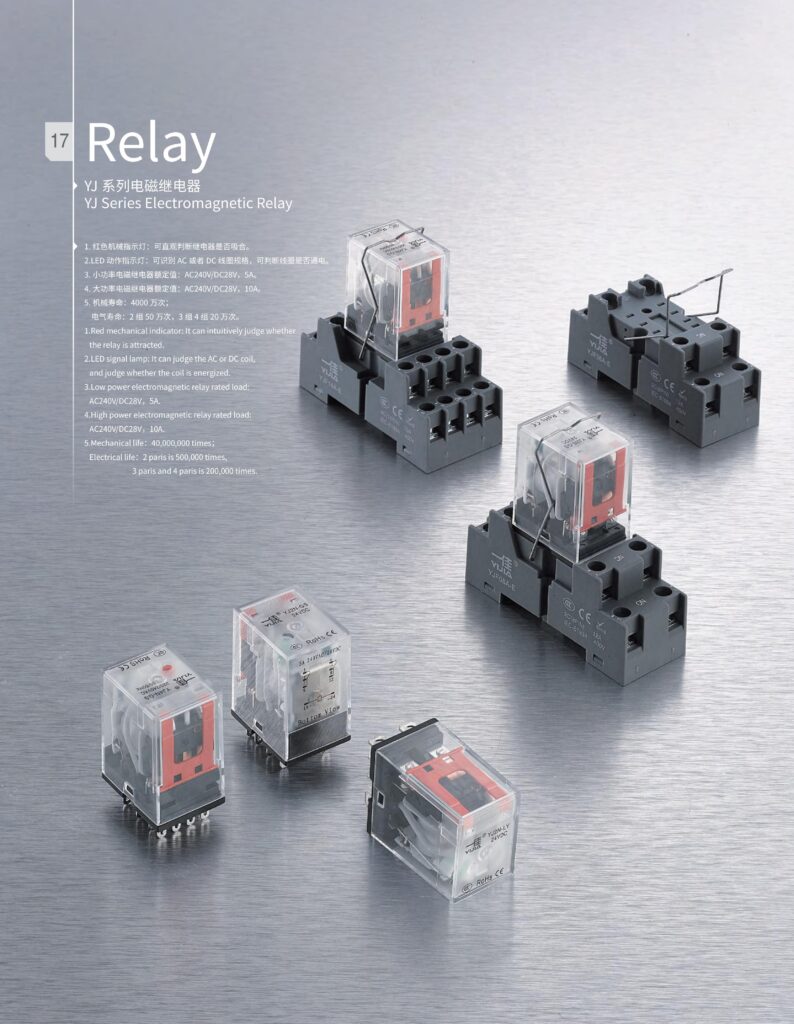
If you’re unsure whether the AC Relay Switch is right for your machine, simply share a sketch, stroke length, and environmental data, YIJIA supplier can recommend a suitable model.
Key Specifications Engineers Check (and Procurement Should Confirm)
This is the part where mismatches cost money. Engineers look at relay specs to prevent field failures. Procurement looks at price, availability, and supplier reliability. You need both.
Below are the specifications that matter most in electrical control applications.
Coil side (control compatibility)
- Rated coil voltage (e.g., 24VAC, 110VAC, 230VAC)
- Coil frequency compatibility (50Hz vs 60Hz)
- Coil consumption (VA or W)
- Pick-up and drop-out voltages
Contact side (load reality)
- Contact configuration (SPST, SPDT, DPDT)
- Contact rating at specified conditions
- Load type: resistive vs inductive vs motor
- Inrush current capability
- Contact material and arc resistance
| Specification | Why it matters | What to write in an RFQ |
|---|---|---|
| Coil voltage & frequency | Prevents chatter and overheating | “Coil: 24VAC 50/60Hz” |
| Contact configuration | Ensures wiring compatibility | “Contacts: SPDT (1 Form C)” |
| Contact rating | Prevents welded or burnt contacts | “Rating: X A at Y VAC, inductive load” |
| Electrical endurance | Predicts service life | “Minimum electrical life: ____ cycles” |
| Ambient temperature | Affects reliability in panels | “Operating: -____ to +____ °C” |
A practical tip for B2B teams: do not accept a quote that lists only “10A” or “30A” without stating the test conditions. Ratings depend on load type, power factor, and switching frequency.
Common Applications in Control Panels and Industrial Equipment
AC relay switches show up anywhere a controller needs to operate something bigger. Some examples are obvious (fans, heaters). Others are surprisingly subtle (interlocks, signal routing, status feedback).
Typical applications include:
- HVAC and building automation panels
- Motor control cabinets (auxiliary control, not the main power switching)
- Compressors, pumps, and solenoid valves
- Lighting control
- Industrial ovens and heating zones
- Power distribution monitoring and alarms
| Application | Load type | Recommended relay focus |
|---|---|---|
| Solenoid valve control | Inductive | Inrush handling, arc suppression |
| Heater switching | Resistive | Continuous current rating, temperature rise |
| Fan control | Inductive / motor | Motor-rated contacts or proper derating |
| Alarm circuits | Light load | Contact reliability at low current (wetting current) |
| Interlock logic | Control duty | Multi-contact configuration, stable coil operation |
If your readers are procurement managers, here’s a friendly reminder they will appreciate: the “same relay” may behave differently when switching a 2A resistive load versus a 2A inductive load. That difference is where service calls are born.
AC Relay vs Contactor vs Solid-State Relay: Selection Guidance
Not every switching problem should be solved with the same component. In fact, one of the most common sourcing mistakes is using an undersized relay where a contactor or SSR is more appropriate.
Here is a practical comparison.
| Device | Best for | Tradeoffs | Typical buying channel |
|---|---|---|---|
| Electromechanical relay switch | General control switching, moderate loads | Contact wear, audible click | Many manufacturers and wholesalers |
| Contactor | High-current motor loads, heavy inrush | Larger size, coil consumption | Industrial suppliers, OEM sourcing |
| Solid-state relay (SSR) | High switching frequency, silent operation | Heat dissipation, leakage current | Specialist suppliers, engineering-driven |
Selection is not just engineering purity; it’s total cost. Over-spec and you waste money. Under-spec and you pay in downtime.
Reliability: Why Relays Fail and How to Reduce Field Issues
Relays fail in patterns. Understanding these patterns is useful both for engineers designing systems and for buyers managing warranty risk.
Common failure modes:
- Contact welding from high inrush or inductive arcing
- Contact oxidation in very low-current signal switching
- Coil burnout due to overvoltage, heat, or poor ventilation
- Chatter due to unstable control voltage or wrong coil frequency
- Mechanical wear after too many cycles
| Symptom | Likely root cause | Practical prevention |
|---|---|---|
| Relay stuck ON | Contact welded | Use proper load rating, add snubber/RC |
| Relay intermittent | Oxidation, vibration | Choose suitable contact material, secure mounting |
| Coil overheats | Overvoltage, high ambient | Verify coil tolerance, panel thermal design |
| Buzzing/chatter | Wrong AC frequency or low voltage | Match 50/60Hz spec, check control transformer |
If you want fewer after-sales surprises, ask suppliers for recommended suppression components and derating curves. It’s a small request that often reveals whether you’re dealing with a real manufacturer or a reseller with a datasheet.
B2B Sourcing: Manufacturers, Suppliers, Wholesalers, and Pricing Reality
Now let’s talk procurement in a way that actually helps.
For relay switch sourcing, you typically have three routes:
- Manufacturers (OEM/ODM capable)
Best for stable supply, engineering support, customization, and long-term pricing. - Authorized suppliers / distributors
Best for fast delivery, authenticity, traceability, and mixed inventory. - Wholesalers
Best for bulk availability and competitive prices, but qualification and documentation can vary.
| Channel | Strengths | Watch-outs | When it fits |
|---|---|---|---|
| Manufacturers | Customization, stable BOM, factory pricing | MOQ, tooling lead time | OEM projects, long-term programs |
| Suppliers/Distributors | Traceability, broad catalog | Higher unit cost | Maintenance stock, multi-SKU purchasing |
| Wholesalers | Competitive prices, volume | Documentation varies | Cost-sensitive bulk orders |
How pricing is usually structured
Relay switch prices are commonly influenced by:
- Coil type and voltage (AC coils can vary)
- Contact rating and material
- Compliance requirements (UL/CE/RoHS)
- Packaging (bulk vs tray vs tape-and-reel)
- Order volume and annual forecast
- Customization needs (marking, terminals, sealing)
| Pricing factor | How it affects cost | What to do in your RFQ |
|---|---|---|
| Higher contact rating | Increases cost | Provide real load requirement |
| Compliance files | May increase cost | State required approvals upfront |
| Custom terminals | Tooling cost possible | Ask for standard alternatives first |
| Packaging format | Impacts logistics cost | Specify your assembly preference |
| MOQ/forecast | Affects unit price tiers | Provide annual volume estimate |
If you’re collecting quotes, make them comparable. Ask every supplier to quote the same: coil voltage/frequency, contact form, load type, approvals, lead time, MOQ, and sample policy.
Customization Options That Matter in Real Projects
Customization is not only about branding. In control systems, it often reduces assembly time, improves safety, or avoids redesigns.
Common customization requests include:
- Coil variants for different regions (e.g., 110VAC vs 230VAC)
- Terminal style changes (PCB pins, quick-connect tabs, screw terminals via base)
- Product labeling (customer part number, lot codes)
- Improved environmental resistance (sealed housing, coating)
- Packaging customization for line feeding
| Customization item | Value for B2B customers | Typical impact |
|---|---|---|
| Coil voltage tailoring | Reduces transformer changes | Medium |
| Terminal/footprint change | Avoids rewiring or PCB redesign | Medium–high |
| Private label marking | Simplifies spares and branding | Low |
| Sealed/coated versions | Improves reliability in humidity | Medium |
| Packaging/kitting | Speeds assembly and reduces damage | Low–medium |
If you’re ready to purchase, one sentence can move the conversation forward: Send an inquiry with your coil voltage, contact configuration, target load type, and mounting style, and a qualified supplier can propose the closest standard part or a customization path.
An AC relay switch is not glamorous. It won’t impress anyone during a factory tour. But it is one of the most practical tools in electrical control: it translates a small command into a reliable switching action, adds isolation between circuits, and helps keep control systems serviceable.
For engineers, the winning approach is clear: specify coil voltage and frequency correctly, respect inductive loads, and design for real-world temperatures and cycle counts. For procurement teams, the path is just as clear: qualify suppliers, compare quotes on consistent specs, and treat “cheap” as a risk category unless endurance and compliance are proven.
If you are sourcing relay switches for control panels, HVAC systems, or industrial equipment—and you want stable supply, predictable quality, and competitive prices—reach out with your coil voltage, contact form, load type, and expected volume. A serious manufacturer or supplier will respond with a matching standard option or a practical customization proposal that reduces your total cost over the product life.
FAQ
It lets a low-power control signal switch a higher-power AC circuit with isolation.
Not safely. Match coil voltage/frequency, contact configuration, and load rating.
Sometimes, but motor/inrush conditions often require derating or a contactor.
Often yes. Suppression reduces arcing and extends contact life.
Manufacturers are better for OEM volume and customization; wholesalers are better for quick bulk supply.