Limit switch might look like a small part in your machine, but for most industrial OEMs and system integrators it is the tiny guardian that keeps production lines safe, repeatable, and traceable. When B2B buyers choose the right limit switch, they gain more than an “on–off” device; they gain reliable position feedback, safety interlocks, and a key building block for automation and predictive maintenance.
What is a limit switch?
A limit switch is an electromechanical device that detects the presence, absence, or position of a moving part by means of a mechanical actuator and an internal switching element. When the actuator is triggered by a cam, door, product, or machine component, the internal contacts change state and send a signal to a PLC, relay, or control system.
Because limit switches have a simple but rugged structure, they are widely used in applications that demand mechanical strength, high repeatability, and environmental resistance that standard basic switches cannot handle. In modern factories, they play an essential role in position sensing, end-of-travel detection, counting, and safety interlocking across a wide range of machinery.
If your project needs stable position feedback in harsh conditions, a properly selected limit switch can often be the most cost-effective and reliable solution—feel free to send your drawings or specs for a tailored quotation.

Key industrial applications
Limit switches are found anywhere a mechanical motion needs to be detected, limited, or confirmed before the next step of a process can continue. They help OEM engineers and maintenance teams automate machine sequences and protect operators and equipment from overtravel or unsafe conditions.
Typical B2B limit switch applications include material handling, packaging lines, machine tools, robotics, process valves, and transportation equipment. In each of these industries, the switch provides simple binary feedback that control systems translate into safe motions, alarms, and interlocks.
Common application scenarios
Conveyor and packaging systems: Limit switches detect product presence, count items, and stop the belt at the end of travel to prevent items from falling or causing jams.
Safety guards and access doors: Mounted on doors, covers, and guards, they provide open/closed status so machines can stop or de-energize when safety barriers are opened.
Machine tools and CNC: Limit switches define home and end-of-travel positions, protecting axes from overtravel and providing repeatable reference points for positioning.
Industrial robots: In robotic arms and grippers, limit switches help detect object presence, confirm joint limits, and prevent collisions between moving parts.
Automated valves and actuators: Limit switch boxes on industrial valves report open/closed positions to DCS/PLC systems, enabling remote monitoring and interlocking in process plants.
Application focus table
| Application area | Main limit switch role | Typical benefit for B2B users |
|---|---|---|
| Conveyors & packaging | Product detection, counting, end-stop | Reduced jams, accurate counting, less scrap |
| Machine tools & CNC | Travel limits, homing, axis reference | Protects mechanics, stable positioning |
| Safety doors & guards | Open/closed detection | Compliance, operator safety |
| Robotics & handling | Object presence, joint limit detection | Accurate motion, collision avoidance |
| Industrial process valves | Valve open/closed feedback | Remote monitoring, interlocking |
| Elevators & hoists | Position and end-travel detection | Safe stopping, smooth operation |
All of these scenarios share one thing: the limit switch becomes a simple but critical sensor in a larger automation and safety ecosystem.
How a limit switch works
Although there are many form factors, the basic operating principle of a limit switch is straightforward. A moving part of the machine (cam, lever, door, product, piston) mechanically bumps or deflects the switch’s actuator, which then transfers motion to an internal mechanism that opens or closes electrical contacts.
The output of the switch is usually a set of normally open (NO), normally closed (NC), or changeover (SPDT/DPDT) contacts, which interface easily with PLC inputs, contactors, relays, and other control devices. Once the actuating force is removed and the mechanism returns to its free position (often with spring force), the contacts revert to their original state, ready for the next cycle.
Functional characteristics
- Snap-action mechanism: Many limit switches use snap-action contacts, ensuring quick, clean switching and reducing contact bounce even at low actuator speeds.
- Mechanical hysteresis (differential travel): There is often a small difference between the actuation point and the release point, which stabilizes switching behavior and prevents chatter around the threshold.
- Repeatability and precision: Industrial-grade designs provide high mechanical repeat accuracy, making them suitable for precise position detection and consistent control sequences.
Working principle overview table
| Feature | Description (simplified) | Why it matters for engineers |
|---|---|---|
| Actuator | Lever, plunger, roller, whisker, etc. | Matches the type of mechanical motion |
| Internal mechanism | Transfers motion to contacts | Converts movement into an electrical signal |
| Contacts | NO, NC, or changeover | Flexible wiring into any control system |
| Snap action | Fast switching over a small travel range | Clear signal, less contact wear |
| Differential travel | Different operating and release positions | Avoids repeated on/off at the same point |
When you design an automation system, understanding these internal characteristics helps you choose appropriate actuation cams and mounting tolerances to ensure consistent switching.
Main types of limit switches
There is no single “best” limit switch; instead, several types are optimized for different installation conditions and motions. Choosing between them depends on actuation direction, required travel, mounting space, and the type of machine motion being detected.
Mechanical limit switches
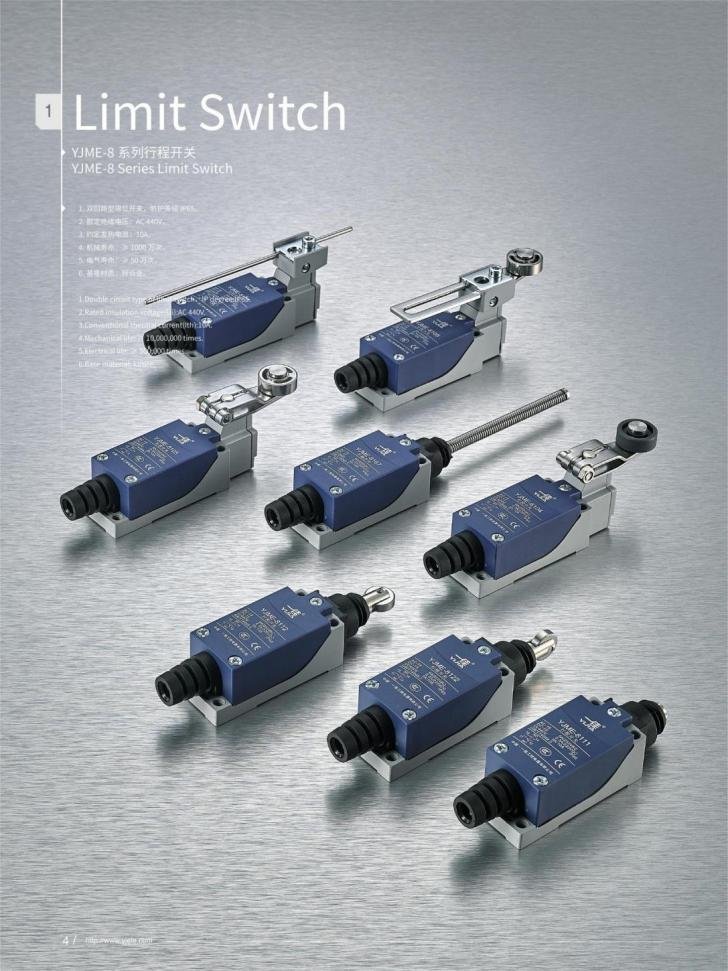
Mechanical limit switches are the classic, most widely used style, where a physical actuator is moved by the target object. They come in many actuator shapes—plunger, roller lever, adjustable lever, rod, or whisker—to adapt to various mechanical designs.
These switches are popular in conveyors, packaging machines, material handling systems, and machine tools because of their robustness, simplicity, and low cost. For B2B buyers, mechanical limit switches are often the default choice because they are easy to install, easy to understand, and compatible with practically any control panel.
Proximity-style and non-contact limit switches
Some manufacturers and users extend the term “limit switch” to certain proximity sensors and non-contact solutions that serve the same end-of-travel or position detection function. Inductive or magnetic non-contact limit switches provide feedback without direct mechanical contact, which is ideal in high-speed, high-cycle, or high-contamination environments.
While these sensors usually cost more than purely mechanical devices, they reduce mechanical wear, are easier to seal, and can support higher switching frequencies, making them attractive for high-end machinery and robotics.
Type comparison table
| Type | Typical actuator/contact style | Ideal use case |
|---|---|---|
| Plunger limit switch | Linear plunger, snap contacts | Precise end-stop on linear motion |
| Roller lever limit switch | Lever with roller, snap contacts | Conveyors, cams, packaging lines |
| Adjustable lever switch | Long lever, adjustable angle | Variable cams, large travel motions |
| Whisker limit switch | Flexible wire “whisker” | Detect small or fragile objects, robotics |
| Non-contact “limit” sensor | Inductive, magnetic, or reed-based detection | High-speed, sealed, or hygiene-critical areas |
If you are not sure which type fits your machine, sharing a simple sketch, stroke length, and environmental data is usually enough for a supplier to recommend a suitable model.
Why B2B buyers specify limit switches
From a B2B perspective, a “limit switch” is never just a part number—it is a risk-control and cost-optimization tool. OEMs, panel builders, and integrators care about reduced downtime, safety compliance, and lifecycle cost, and a well-chosen industrial limit switch supports all three.
Core business benefits
- Improved safety: Limit switches act as safety interlocks in guards, automatic doors, elevators, and hoists, preventing hazardous motion when a limit is exceeded or a barrier is opened.
- Higher uptime and less damage: By stopping overtravel and sensing misalignment before a mechanical crash, limit switches help avoid broken components, bent shafts, and unplanned downtime.
- Consistent quality: In packaging and assembly lines, repeatable position feedback keeps operations synchronized, avoiding under-filling, misaligned labeling, or incorrect assembly steps.
- Easy integration: With standardized contact ratings and mounting interfaces, industrial limit switches plug directly into PLC, DCS, or relay-based control systems with minimal engineering effort.
B2B decision factors table
| Buyer concern | How limit switches help | Impact on operations |
|---|---|---|
| Safety compliance | Provide guard/door and end-travel interlocks | Easier standards compliance, fewer incidents |
| Maintenance cost | Prevent overtravel and collisions | Less mechanical damage and repair cost |
| Production quality | Stable position feedback | Fewer defects and rejects |
| Integration time | Standard contacts and mounting | Shorter design and commissioning cycles |
When selecting a limit switch supplier, many B2B customers also look at documentation, certifications, and customization options such as special actuators or pre-wired connectors.
Key selection criteria for engineers
Selecting the right limit switch model is an engineering decision that balances electrical, mechanical, and environmental requirements. Getting these basics right ensures long service life and trouble-free integration into your control system.
Electrical and mechanical ratings
Start with the electrical rating: operating voltage, current, AC or DC, and load type (inductive, resistive, motor). The contacts must handle inrush currents and switching frequency with enough margin to avoid premature wear or welding.
Then check the mechanical rating: permissible operating speed, maximum operating frequency (operations per minute), and mechanical life in cycles. This is especially important in high-speed counting applications or robotic systems where the switch may operate thousands or millions of times per year.
Environmental and mounting factors
Limit switches designed for industrial environments are available with sealed housings, metal bodies, and NEMA/IP-rated enclosures to resist dust, oil, moisture, chemicals, and extreme temperatures. Choosing the right enclosure and actuator material ensures reliable switching even in dirty or outdoor settings.
Mounting style and actuator geometry also matter. Side-mounted roller levers suit conveyor edges, while top plungers match vertical stroke motions; compact miniature switches can fit inside tight control boxes or robotics joints. Taking the time to align actuator travel with machine motion reduces side-loading and prolongs service life.
Practical selection table
| Parameter | What to check | Typical engineering question |
|---|---|---|
| Voltage & current | Rated AC/DC voltage and current | Does it match my PLC/relay/load? |
| Contact configuration | NO, NC, changeover, number of poles | How many signals do I need per position? |
| Mechanical life | Rated operations and operating frequency | Will it survive my duty cycle? |
| Enclosure rating | NEMA/IP, material, sealing | Will it resist dust, oil, moisture, washdown? |
| Actuator style | Plunger, roller lever, rod, whisker | Does it match my cam or motion direction? |
If you share these parameters along with your target application, a supplier can usually propose a matching “limit switch solution” within a short time.
Limit switch vs. other position sensors
Many engineers ask: “Should I use a limit switch, an inductive sensor, or an encoder?” That is a fair question, as modern automation offers many sensing options. Limit switches stand out when you need simple binary position feedback with mechanical robustness and low cost.
Proximity sensors and encoders shine when you need non-contact detection or continuous position feedback, but they usually come with higher unit cost and often require more careful wiring and protection. For end-of-travel detection, collision prevention, and safety interlocking, a mechanical limit switch often remains the most economical and straightforward choice.
| Device type | Output style | Best use |
|---|---|---|
| Limit switch | Binary (on/off contacts) | Travel limits, safety interlocks, counting |
| Inductive sensor | Binary electronic signal | Non-contact metal detection, high cycle rate |
| Optical sensor | Binary or analog | Small object detection, clear/no-contact sensing |
| Encoder | Incremental/absolute | Continuous position/speed feedback |
In many advanced machines, you will actually find both: encoders for continuous control and limit switches as safety and reference points.
smart limit switch solutions
Limit switches are evolving along with Industry 4.0 requirements. Many manufacturers now offer limit switch boxes for valves, which integrate mechanical switches or sensors with local visual indicators and sometimes even communication interfaces. These assemblies simplify wiring and make it easier to monitor valve states across an entire plant.
There is also a trend toward more compact, sealed, and high-durability designs that can survive more cycles, more vibration, and more aggressive environments, especially in robotics and transportation. For B2B customers, this means fewer replacements, longer maintenance intervals, and better total cost of ownership across the lifecycle of the machine.
Trend snapshot table
| Trend | What changes in the limit switch | Benefit for B2B users |
|---|---|---|
| Integrated valve boxes | Switches + mechanical housing + indicator | Easier installation and monitoring |
| Higher sealing & durability | Better materials and higher IP/NEMA rating | Longer life in harsh environments |
| Miniaturization | Smaller, lighter actuators and housings | Easier integration into compact equipment |
If your project roadmap includes digitalization or remote monitoring, discussing “smart” limit switch or box options during the design phase can prevent costly retrofits later.
For many B2B buyers, a limit switch is a low-cost line item, but it can quietly control uptime, safety, and quality across the entire machine or production line. With the right type, rating, and mounting, this small device becomes a reliable position sensor and safety guard that works in the background for millions of cycles.
When planning your next conveyor system, packaging line, robot cell, or automated valve project, taking an extra hour to specify the correct limit switch can pay back with years of smooth, trouble-free operation. If you are comparing models or planning a new machine, you are welcome to send your application data—stroke, speed, environment, and IO type—so a tailored limit switch proposal and quotation can help you shorten design time and reduce risk.
FAQ
A limit switch detects when a moving part reaches a defined position or end-of-travel and then changes its electrical contacts to start, stop, or interlock machine functions.
Match the actuator to the motion: plungers for straight linear strokes, roller levers for cams and conveyors, and whisker/rod actuators for irregular or delicate objects.
Yes, many limit switches are used as part of safety interlocks on doors, guards, and travel limits, but safety design must follow relevant standards and often uses redundant channels and certified components.
Industrial limit switches with appropriate NEMA or IP ratings and sealed housings are designed for dust, oil, moisture, and temperature extremes, making them suitable for heavy-duty environments.
Mechanical life is often specified in hundreds of thousands or millions of operations, depending on model, load, and installation quality.
Many manufacturers support custom actuators, cable assemblies, connectors, and mounting brackets for OEM or large-volume projects, often with dedicated engineering support.