If you’ve ever stood in front of a control panel wondering, “Is this AC relay switch enough, or do I really need a contactor?”, you’re not alone.
From the outside, an AC relay switch and an AC contactor look like cousins. Inside, for industrial applications and B2B purchasing decisions, they behave very differently.
In this article, I’ll walk you through how an AC relay switch works, what makes an AC contactor special, and most importantly, how to choose the right one for your motor control, HVAC panel, lighting control cabinet or OEM machinery. We’ll keep it practical, with examples, a few jokes, and clear tables you can forward directly to your sourcing team or your supplier.
What Is an AC Relay Switch?
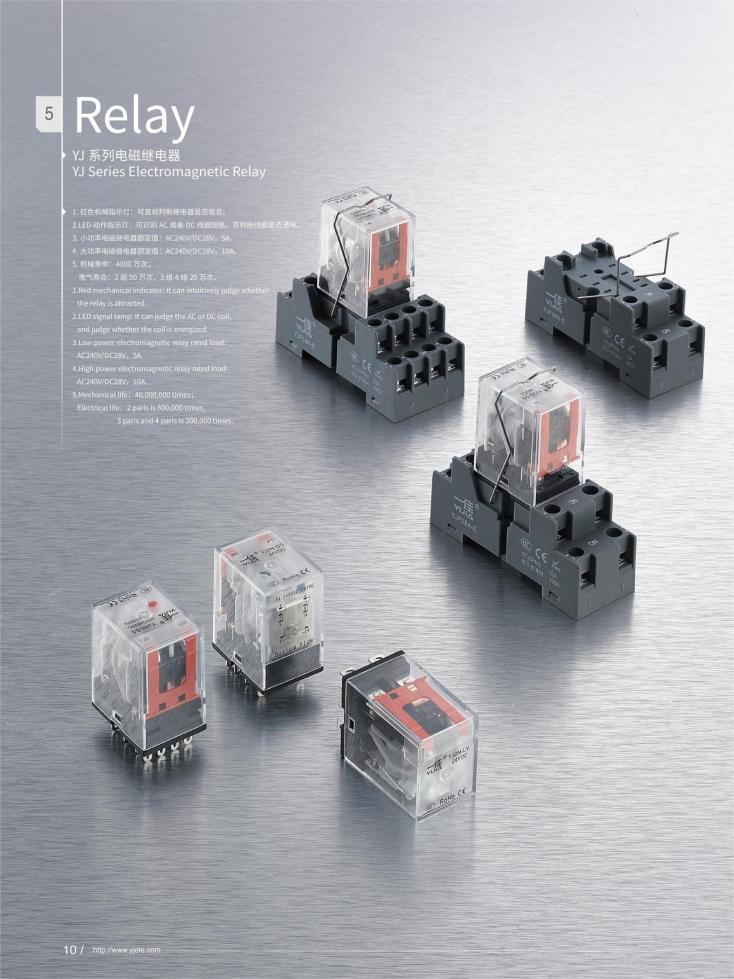
An AC relay switch (often simply called an AC relay) is an electrically operated switch designed mainly for low‑ to medium‑power AC control circuits. In industrial panels, you usually find it on the control side, not directly on the heavy‑duty power line.
The basic idea is simple: a coil, some contacts, and a small miracle of magnetism. When the coil is energized by a control voltage (for example 24 V AC, 110 V AC, or 230 V AC), it pulls a set of contacts to change state. That’s how an AC relay switch translates a low‑power control signal into switching a slightly higher‑power AC load or another control device.
In many control cabinets, AC relays work together with PLC outputs, push buttons, limit switches and sensors. They are ideal in signal amplification, interlocking logic and status feedback, especially when you need multiple changeover contacts in a compact device.
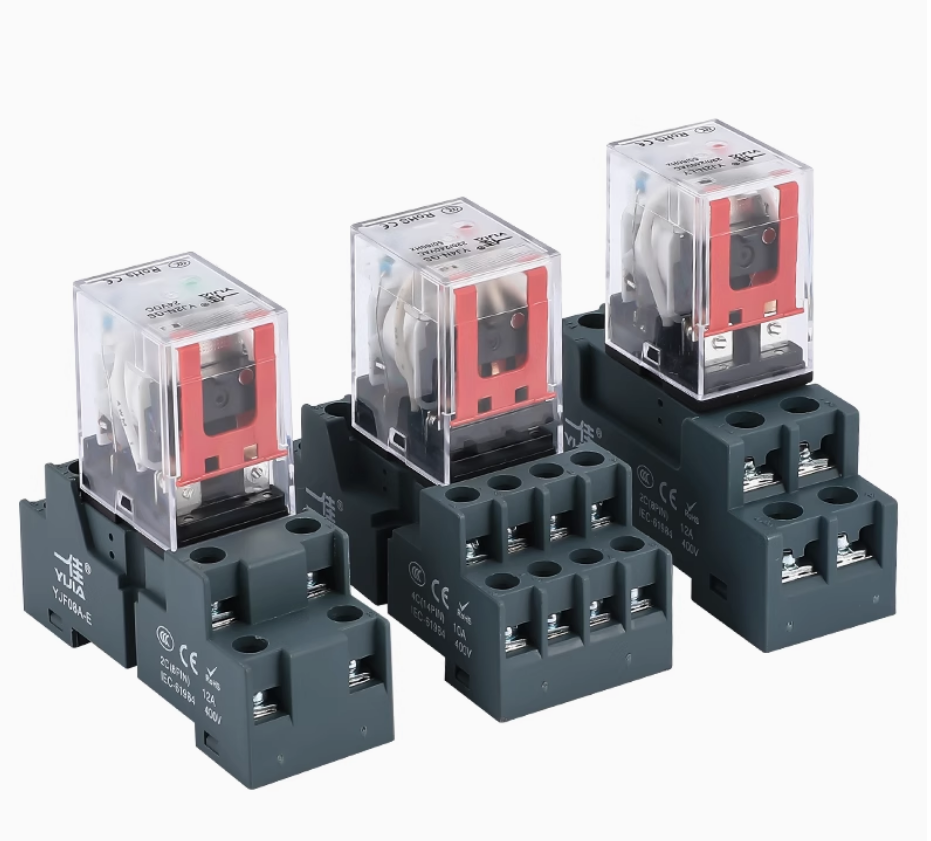
Typical Data Range Table for AC Relay Switches
Below is a general‑purpose reference table you can show to your buyer or design engineer when planning control circuits with AC relay switches:
| Parameter | Typical AC Relay Switch Range | Notes for B2B Buyers |
|---|---|---|
| Coil rated voltage (AC) | 12–240 V AC | Match PLC / control voltage. |
| Contact current rating | 1–5 A AC | Mostly for control or small loads. |
| Number of contacts | 1–4 changeover (SPDT/DPDT) | Useful for interlocking logic. |
| Electrical endurance | 100k–1M operations | Depends on load type (AC‑15, AC‑14 etc.). |
| Insulation coordination | Up to around 250–440 V AC | Check standards for your market. |
| Typical applications | Signal switching, interface relays, small solenoids, indicator lamps | Not for large motors. |
Because of these ratings, an AC relay switch is perfect when you want to drive:
- Small AC solenoid valves
- Signal lamps and buzzers
- Auxiliary coils (for example, the coil of a larger AC contactor)
- Control circuits in HVAC and building automation
If you are now thinking about switching a 22 kW motor directly with an AC relay switch, we need to talk.
What Is an AC Contactor?
An AC contactor is a heavy‑duty power switching device designed to make and break higher current AC loads, especially motors, compressors, pumps and big heating elements. While an AC relay switch lives comfortably in the control circuit, the contactor lives in the main power circuit and takes the real punishment.
Just like a relay, a contactor also has a coil and contacts. The difference is scale: the contactor has large main contacts, arc‑chutes or arc‑suppression design, and usually a more robust housing. This allows it to interrupt high inrush currents and inductive loads without welding itself into a useless block of metal.
In industrial motor control centers, AC contactors are everywhere: in DOL starters, star‑delta starters, soft starter bypass circuits, and motor reversing starters. If you are sourcing components for such systems, “AC contactor selection” is one of the most important decisions you will make.
Typical Data Range Table for AC Contactors
Here’s a simplified view of what an AC contactor looks like on paper:
| Parameter | Typical AC Contactor Range | Notes for B2B Buyers |
|---|---|---|
| Coil rated voltage | 24–400 V AC (sometimes DC) | Choose according to control system. |
| Main contact current rating | 9–800 A AC | Wide range for motors and feeders. |
| Utilization category | AC‑3, AC‑4, AC‑1 etc. | AC‑3 is common for squirrel‑cage motors. |
| Number of main poles | 3 or 4 | 3‑pole typical for three‑phase motors. |
| Auxiliary contacts | 1–4 NO/NC | For feedback, interlocks, signaling. |
| Arc suppression | Integrated arc chambers | Key difference vs. most relays. |
| Typical applications | Motor starters, pump control, HVAC compressors, power distribution | Main power circuit. |
This is why, if you’re responsible for motor control procurement, “AC contactor for motor” or “AC contactor for compressor” will appear in your RFQ much more often than “AC relay switch”.
AC Relay Switch vs Contactor: The Core Differences
Now, let’s answer the question you actually care about: when you look at an AC relay switch and an AC contactor, what are the practical differences for your project and your purchasing list?
1. Power Level and Load Type
An AC relay switch is designed for low‑power or medium‑power loads in control circuits.
An AC contactor is designed for high‑power loads in the main circuit.
If you are switching:
- A 24 V indicator lamp → AC relay switch is fine.
- A 3‑phase 11 kW motor → AC contactor, absolutely.
Using a relay where a contactor is required is like using a toy screwdriver on a 2‑ton machine. It might work once, but you really don’t want to bet your production line on it.
2. Contact Design and Arc Suppression
AC relay switches typically do not include advanced arc‑suppression features.
They can switch AC loads but are not optimized for frequent breaking of high inrush currents.
On the other hand, most AC contactors have:
- Larger contact surfaces
- Better contact materials for high‑current AC switching
- Arc‑chutes or other arc‑suppression structures
This is critical for AC motor control and heavy inductive loads.
3. Application Position in the Circuit
Relays are usually in the control circuit.
Contactors are usually in the power circuit.
A common industrial example:
- PLC output → drives an AC relay module or interface relay.
- Relay contact → energizes the coil of an AC contactor.
- AC contactor → switches the 3‑phase motor supply.
So, when you are planning your BOM for an OEM machine, you often need both: AC relay switches for logic and interlocking, and AC contactors for main power switching.
4. Size, Noise and Mounting
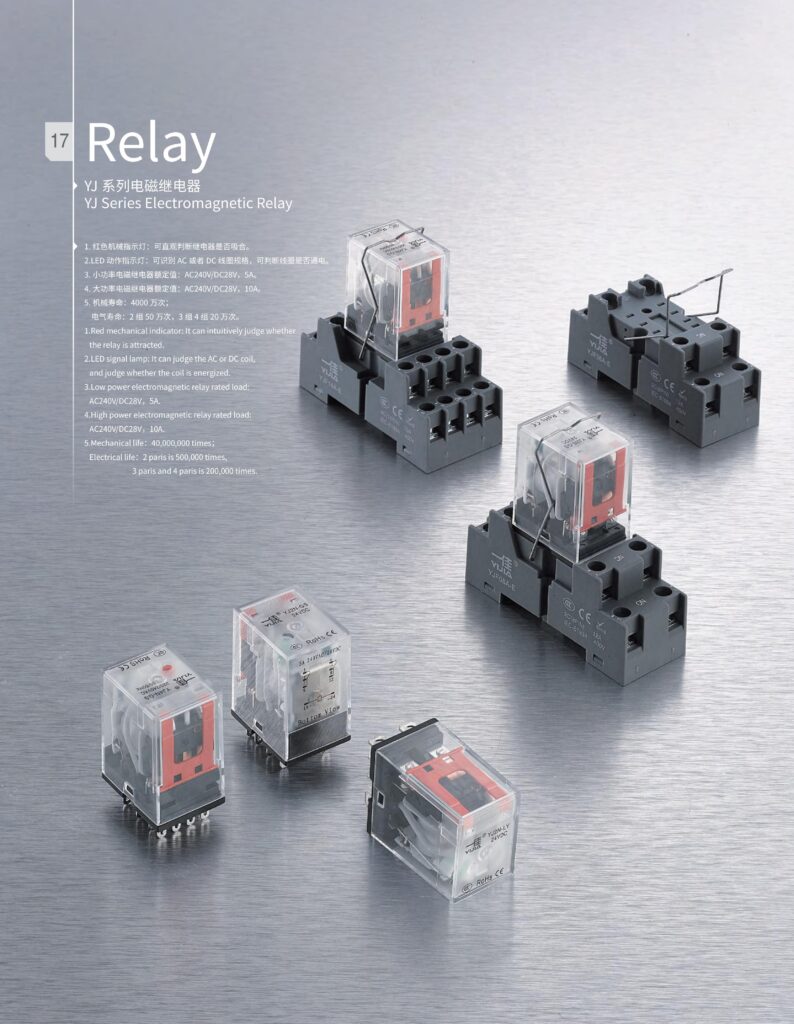
AC relay switches tend to be small, compact, and often plug‑in types or slim DIN‑rail units.
AC contactors are bigger, heavier and usually produce a more audible “clack” when operating.
From a panel design point of view:
- Relays save space in dense control cabinets.
- Contactors demand more depth and spacing because of heat and wiring clearances.
5. Cost and Total Ownership
Typically:
- Unit price of an AC relay switch is lower.
- Unit price of an AC contactor is higher, but it’s built to survive tougher conditions.
However, if you misuse an AC relay switch as a power contactor, your replacement cost, downtime cost and safety risk can be huge. So the cheaper part may end up being the most expensive decision.
Quick Comparison Table
| Aspect | AC Relay Switch | AC Contactor |
|---|---|---|
| Main function | Control / signal switching | Power switching for high loads |
| Typical current | About 1–5 A | 9 A and above |
| Circuit location | Control side | Main power circuit |
| Arc suppression | Basic or none | Dedicated arc‑chutes, better design |
| Typical application | PLC interface, small loads, logic circuits | Motors, pumps, compressors, heating loads |
| Size | Compact, often plug‑in or slim DIN‑rail | Larger, robust DIN‑rail or base mounting |
| Best for B2B use | Control panels, signal interfaces | Motor control centers, distribution boards |
When Should a Buyer Choose an AC Relay Switch?
If you’re sourcing components for control panels, OEM equipment or automation systems, you should consider an AC relay switch when:
- The load current is relatively low.
- You mainly switch signals, not large motors.
- You need multiple changeover contacts for complex interlocks.
- Space is limited and you want a slim control solution.
In B2B sourcing, typical phrases you might see in RFQs include:
- “AC relay switch module for PLC output isolation”
- “AC relay switch for low‑power AC load”
- “Industrial AC relay module 230 V coil”
These AC relay switch modules often come with LED indicators, test buttons and pluggable bases, making maintenance easier. For OEMs shipping thousands of control boxes, this can significantly reduce field service time.
If you’re not sure whether a particular load is suitable for an AC relay switch, send the load data (voltage, current, load type, switching frequency) to your supplier and ask for a recommendation. One email today can save you a service call tomorrow.
When Should a Buyer Choose an AC Contactor?
You reach for an AC contactor if your application includes:
- Three‑phase motors for pumps, fans, conveyors and compressors
- Large resistive loads such as electric heaters
- Frequent start/stop duty (for example AC‑3 motor category)
- Integration with overload relays for motor protection
Common procurement terms you see in requests:
- “AC contactor for 7.5 kW motor, 400 V”
- “AC contactor with auxiliary contacts for remote monitoring”
- “AC motor contactor with 24 V AC coil”
For example, a water treatment plant might require:
- AC contactors for pump motors
- Auxiliary contacts for remote status indication
- Mechanical interlocks for forward/reverse starters
In that scenario, an AC relay switch simply cannot replace the contactor. It doesn’t have the breaking capacity, the mechanical endurance or the safety margin required.
If you’re preparing a new project RFQ, feel free to share your load data and control voltage with your preferred supplier and ask them to quote a matched AC relay switch plus contactor set. That way, the whole AC control system is consistent.
Can an AC Relay Switch Replace a Contactor?
This is probably the most common “shortcut” question from cost‑driven projects.
In general:
- A contactor can sometimes replace a relay (over‑engineering, but safe).
- A relay should not replace a contactor for high‑power loads.
Even if the contact rating on a relay seems to match the nominal current, the inrush current, duty cycle, and arc energy for an AC motor or large inductive load are very different from a simple resistive lamp. The result of pushing a relay beyond its comfort zone can be:
- Overheating
- Contact welding
- Insulation breakdown
- In the worst cases, fire or serious equipment damage
So, if your spec says “AC contactor” and your budget says “AC relay switch”, please listen to the spec this time.
How AC Relays and Contactors Work Together in AC Control Systems
In real‑world AC control cabinets, it’s rarely “relay or contactor”.
Most of the time, you use both.
A typical AC motor control architecture:
- PLC or control module outputs a small control signal.
- An AC relay switch (or relay module) interfaces and conditions that signal, sometimes combining multiple logic conditions.
- The relay’s contact energizes the coil of the AC contactor.
- The contactor’s main contacts switch the motor’s three‑phase power.
- Auxiliary contacts from the contactor feed back status to the PLC or indicator lamps.
In this way, the AC relay switch acts as the “brain’s fingers,” while the AC contactor is the “muscle.”
You wouldn’t go to the gym with only fingers, right?
Key Selection Tips for Procurement and B2B Buyers
When specifying AC relay switches:
- Confirm coil voltage: match PLC/output module voltage (e.g. 24 V AC).
- Check contact rating vs. real load type (AC‑15 for control of electromagnetic loads, etc.).
- Decide on the number of contacts required for your interlocking logic.
- Consider module format: pluggable, DIN‑rail, slim relays for high‑density panels.
When specifying AC contactors:
- Define rated operating current and utilization category (e.g. AC‑3 at 400 V).
- Match coil control voltage to your control circuit.
- Decide if you need auxiliary contacts for feedback or interlocking.
- Plan mechanical coordination with overload relays and protective devices.
If you’re preparing a BOM and need a quick cross‑check, you can always send your motor power, line voltage and desired control voltage to your supplier and ask for a recommended AC contactor model plus suitable AC relay switch options.
And if you’re already comparing quotes, don’t just compare price. Look at:
- Product certifications (for example CE, UL, CCC for your markets)
- Mechanical and electrical endurance
- Response time and coil consumption (especially for energy‑efficient panels)
A slightly higher‑spec AC contactor or industrial AC relay can pay for itself quickly by avoiding nuisance shutdowns and maintenance calls.
To wrap it up, an AC relay switch and an AC contactor may look similar, but they play very different roles in your AC control system. The relay is your flexible control specialist in the low‑power world; the contactor is your heavy‑duty workhorse in the main power circuit.
If you’re designing or sourcing for industrial projects—whether it’s motor control centers, HVAC equipment, pumps, or OEM machinery—choosing the correct combination of AC relay switches and AC contactors will directly affect reliability, safety and total cost.
If you’d like a recommendation tailored to your project, just share your load data, control voltage and application scenario, and you can get a matched selection of AC relay switches and AC contactors ready for quotation or sampling.
FAQ
An AC relay switch is mainly for low‑power control circuits, while an AC contactor is designed to switch higher‑power AC loads such as motors and heaters.
In most cases, no. For three‑phase motor control, use an AC contactor with the correct current rating and utilization category.
Electrically it often can, but it is usually over‑sized, more expensive and takes more space, so it’s not a cost‑effective way to handle small control signals.
It is normally installed in the control circuit, between the PLC or control device and other components, to perform signal switching and logic functions.
It is installed in the main power circuit to switch three‑phase motors, pumps, compressors, fans or large resistive loads on and off.
Send motor power, line voltage, load type, duty cycle and desired coil voltage. This allows the supplier to recommend a suitable AC contactor and, if needed, matching AC relay switches.