If you work in industrial automation, HVAC, machinery, or power distribution, you have probably asked this question: “Should I use an AC relay switch or an AC contactor for this project?” For many B2B buyers, this choice directly affects safety, reliability, and maintenance cost over the life of the system.
The problem is that relays and contactors look similar at first glance. Both are electromagnetic switches. Both can control AC loads. But they are not interchangeable. Choosing the wrong device can lead to welded contacts, nuisance trips, or even equipment failure.
In this article, you will clearly understand the difference between an AC relay switch and an AC contactor, see typical industrial use cases for each, and learn how to choose the right solution for your next panel build or equipment upgrade.
What Is an AC Relay Switch?
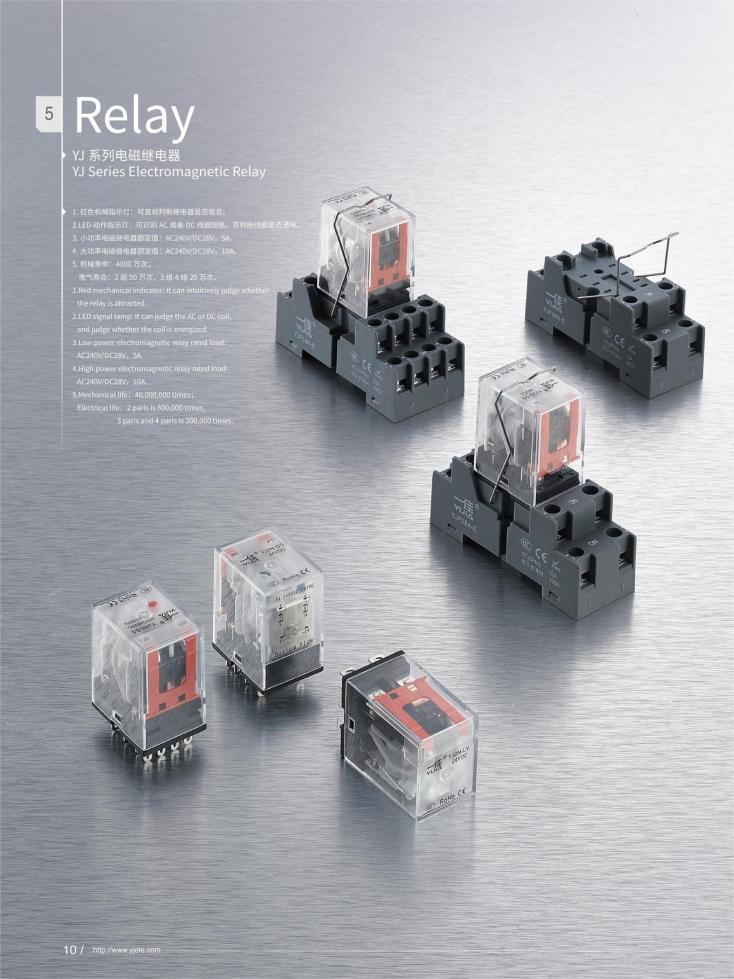
An AC relay switch is an electrically operated switch that uses a low‑power coil signal to control one or more AC load circuits. When the coil is energized, it pulls contacts together (or apart) to open or close the circuit.
In industrial control systems, AC relay switches are typically used for low to medium current loads, signal isolation, and logic-level control rather than for heavy power switching. They are common in PLC panels, HVAC controllers, control cabinets for conveyors, packaging lines, and many other automation systems.
Key Features of AC Relay Switches
- Designed for low to medium load currents, often up to around 10 A depending on model.
- Available for different coil voltages (for example 24 VAC, 110 VAC, 230 VAC) so they can be driven directly from control circuits.
- Often include multiple changeover contacts (NO/NC) for flexible control and feedback signaling.
- Compact size, easy DIN‑rail mounting, and pluggable bases make them ideal for dense control panels.
Typical Applications of AC Relay Switches
AC relay switches show up in many “control before power” use cases:
- Signal switching between PLC and field devices in industrial automation.
- Sequence control in packaging machines, conveyors, and assembly lines.
- HVAC control for fans, dampers, valves, and small single‑phase motors.
- Overload, overvoltage, or undervoltage protection when used as part of a protection relay scheme.
These devices are especially popular in “AC relay switch for HVAC control” and “AC relay switch for industrial automation panel” type applications, where compact size and flexible control logic are more important than heavy power switching.

Summary Table: AC Relay Switch Basics
If your project needs compact control, flexible logic, and moderate load switching, an AC relay switch is often the most cost‑effective choice.
What Is an AC Contactor?
An AC contactor is also an electrically operated switch, but it is built to handle higher current and higher voltage power circuits, especially for motors, heaters, compressors, and 3‑phase loads.
Unlike small relays, AC contactors are usually larger, more robust, and optimized for frequent switching of heavy inductive loads. You will see them in motor control centers (MCCs), pump stations, chillers, and industrial machinery where safe and reliable power switching is critical.
Key Features of AC Contactors
- Designed for high-load circuits, often above 9–10 A and up to hundreds of amps, depending on frame size.
- Rated for higher voltages, often up to 690–1000 VAC for the main contacts.
- Include arc suppression and larger contact gaps to safely interrupt high inrush currents and inductive loads.
- Frequently used with overload relays to create complete motor starters.
Typical Applications of AC Contactors
AC contactors are the standard answer whenever you have high-power AC loads:
- Motor starters for pumps, compressors, conveyor drives, and fans.
- Electric heater banks and large resistive loads in process control.
- Switching 3‑phase power distribution feeders or large single‑phase loads.
- HVAC compressor and large blower control in commercial and industrial buildings.
These meet queries like “AC contactor for 3 phase motor control” or “industrial AC contactor for chiller compressors” where reliability and electrical endurance are more important than panel space.
Summary Table: AC Contactor Basics
If your question is “AC relay switch or AC contactor for 5.5 kW motor?”, the safe answer is almost always an appropriately sized contactor with proper overload protection.
AC Relay Switch vs. AC Contactor: Key Differences
Now let’s answer the big question: what is the real difference between an AC relay switch and an AC contactor, and when should you choose each one? While both are electromagnetic switches, they are optimized for very different jobs.
In simple terms, an AC relay switch is a control‑level device for low to medium loads, while an AC contactor is a power‑level device for higher loads and heavy-duty switching. This affects load capacity, size, safety features, lifespan, and of course, price.
Side‑by‑Side Comparison Table
How to Decide in Real Projects
When you are deciding between an “AC relay switch vs. AC contactor for industrial machine”, ask a few simple questions:
- What is the load current and voltage?
- How often will the device switch?
- What are the safety and compliance requirements?
If you are not sure which one fits your motor or heater load, it is always safer to discuss your application data (voltage, current, duty cycle, environment) with your relay supplier and get a specific selection.
And if you are looking for a reliable AC relay switch manufacturer or AC contactor supplier for OEM or panel‑builder projects, feel free to send your load and quantity requirements for a tailored recommendation.
Application Table: Where Each Device Fits
If you see your project in any of these examples and you are planning a new build or retrofit, this is a good moment to check whether the selected device is correctly sized and properly certified for your target market.
How to Choose the Right AC Relay Switch for Your Project
Once you know you need an AC relay switch instead of a contactor, the next step is choosing the correct model. This is where many B2B buyers search for “industrial AC relay switch selection guide” or “how to choose AC relay switch for control panel”.
Here are the main points to consider.
Key Selection Parameters
- Contact rating: Match the relay’s voltage and current rating to the load, and add safety margin for inrush and inductive behavior.
- Coil voltage: Choose a coil compatible with your control voltage, such as 24 VAC or 220 VAC.
- Contact configuration: Decide how many NO/NC contacts and which type (SPDT, DPDT, etc.) you need for your control logic.
- Mounting style: Plug‑in base, PCB mount, or DIN‑rail module depending on your panel design.
- Certifications: For export equipment, check for CE, UL, or other required approvals.
Selection Checklist Table
If you share your load data and control scheme, a supplier can quickly recommend the right AC relay switch model and base, and even pre‑assemble relay modules for faster panel wiring.
How to Choose the Right AC Contactor
For higher power, the selection of an AC contactor becomes even more critical. Searching “AC contactor sizing for 3 phase motor” or “AC contactor for 22kW motor” is common among engineers and panel builders. Here are the main criteria.
Key Selection Parameters
- Motor or load current: Use the full-load current and duty cycle to select the frame size.
- Utilization category: For example, AC‑3 for squirrel-cage motors, AC‑1 for resistive loads.
- Voltage and phase: System voltage (e.g., 380/400/415 VAC) and whether the load is 3‑phase or single‑phase.
- Coil voltage and control circuit: Match to control supply and consider whether you need low‑voltage coils for safety.
- Accessories: Overload relays, auxiliary contacts, mechanical interlocks for reversing starters, etc.
When in doubt, slightly oversizing the contactor (within sensible limits) and pairing it with the correct overload relay can extend service life and reduce unplanned downtime.
For B2B buyers, the real question is not just “What is the difference between an AC relay switch and an AC contactor?”, but “Which device will make my system safer, more reliable, and easier to maintain over the next 10 years?”.
AC relay switches shine in control circuits, signal switching, and small load applications where flexibility, compact size, and low cost matter most. AC contactors are the workhorses for motors, heaters, and heavy industrial loads where safety, electrical endurance, and compliance are critical.
If you are designing control panels, upgrading existing equipment, or sourcing components for OEM production and you need a trusted AC relay switch and AC contactor supplier, you are welcome to share your load data, target markets, and annual volume. A tailored selection of AC relay switches and contactors can help you reduce downtime, simplify wiring, and improve the reliability of every panel you ship.
FAQ
No. An AC relay switch is designed for low to medium current loads, not for heavy motor or heater loads. Using a relay where a contactor is required can cause overheating, welded contacts, and early failure.
Technically yes, but it is not economical. Contactors are larger, more expensive, and their coils consume more power, so they are not ideal for simple signal or small-load switching where a compact AC relay switch works well.
Both are used in HVAC, but for different tasks. AC relay switches handle low‑power devices such as valves and small fans, while AC contactors control compressors, large blowers, and electric heater stages that need higher current switching.
Solid-state relays can work as AC relay switches and offer fast, silent switching with long life at high switching frequency. However, they generate heat, may need heat sinks, and require proper short‑circuit and overload protection.
Choose based on your control system design. Low-voltage coils like 24 V are common in safe control circuits inside panels, while 220 V coils can simplify wiring if you already have that voltage available, but they demand stricter insulation and safety practices.
Yes. Both AC relay switches and AC contactors can be driven by PLCs, BMS, or other controllers, directly or through interface modules, and they can provide auxiliary contacts for status feedback to your automation system